What Is an Ultrasonic Vibrating Screen?
An ultrasonic vibrating screen, also known as an ultrasonic vibro sifter or ultrasonic sieving machine, is designed for fine and ultrafine powder screening. It combines conventional rotary vibration with high-frequency ultrasonic vibration transmitted directly to the screen mesh. This helps prevent mesh blinding and clogging caused by fine, sticky, or electrostatic powders, improving screening efficiency and maintaining consistent material flow. The machine is widely used for particle size classification and impurity removal in pharmaceutical, food, chemical, metal powder, and powder coating applications.
Applications
The ultrasonic sieving machine is used for fine powder classification, oversize particle removal, product recovery, and precision sieving across pharmaceutical, food, chemical, metal powder, and advanced material industries. By combining rotary screening with high-frequency ultrasonic vibration, the equipment reduces mesh blinding caused by particle adhesion, agglomeration, and electrostatic effects. Screen mesh specifications, contact materials, and discharge configurations can be selected according to material properties and process requirements.
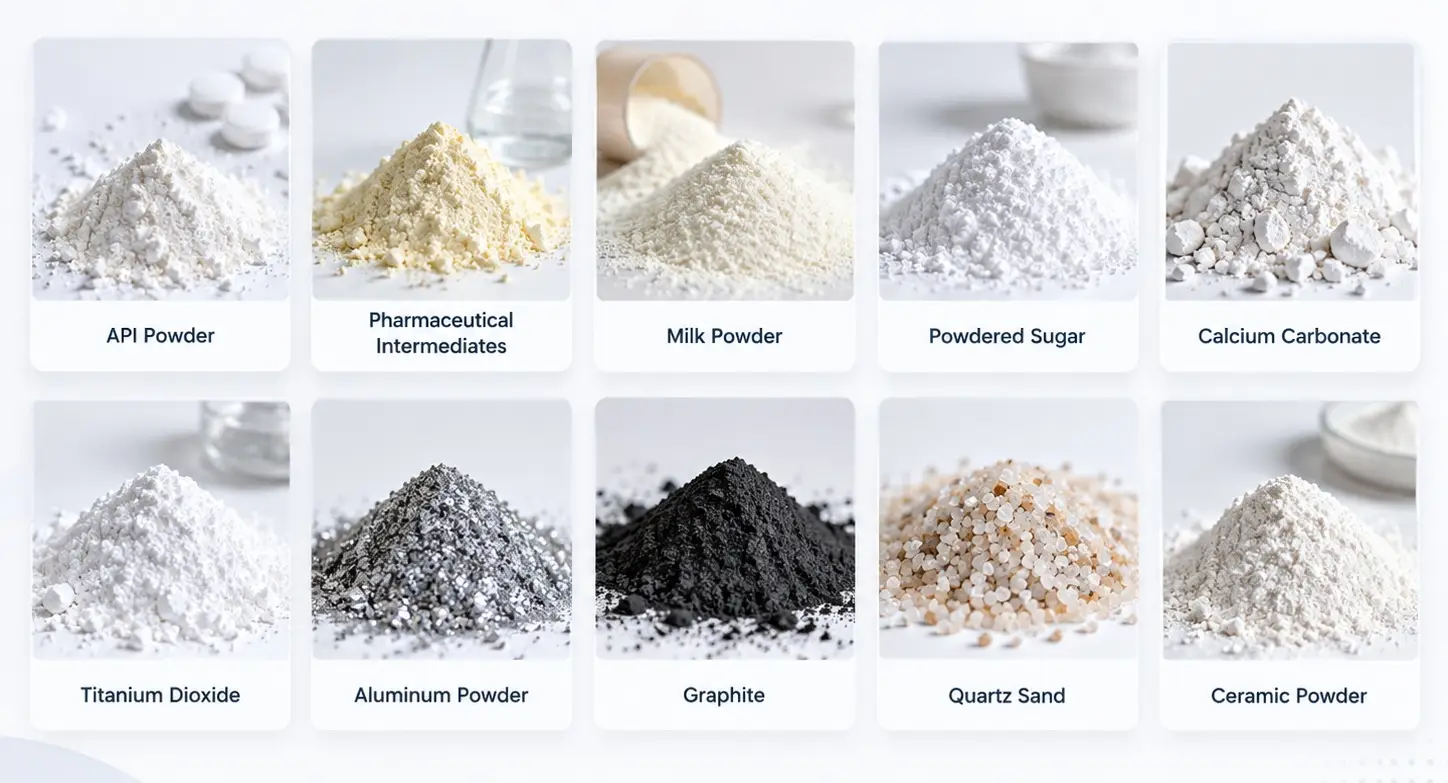
Industrial Applications & Materials
| Industry | Typical Materials | Screening Applications |
| Pharmaceutical Processing | APIs, pharmaceutical intermediates, excipients | Fine powder classification, agglomerate removal, and pre-blending sieving. |
| Food & Beverage Processing | Flour, starch, milk powder, soybean protein, powdered sugar | Ingredient grading, oversize removal, and screening before mixing or packaging. |
| Chemical Processing | Calcium carbonate, titanium dioxide, pigments, resin powders | Fine particle classification, agglomerate separation, and quality screening. |
| Metal Powder Processing | Aluminum, copper, stainless steel, alloy powders | Particle size control, oversize removal, and powder recovery. |
| Powder Coatings | Epoxy powder, polyester powder, coating pigments | Oversize removal and recovery of reusable coating powders. |
| Battery Materials | Graphite, conductive carbon, cathode and anode powders | Fine powder screening and removal of oversized particles. |
| Minerals & Advanced Ceramics | Quartz, silicon carbide, alumina, ceramic powders | Fine particle grading and separation of coarse particles or agglomerates. |
How Does an Ultrasonic Vibrating Screen Work?
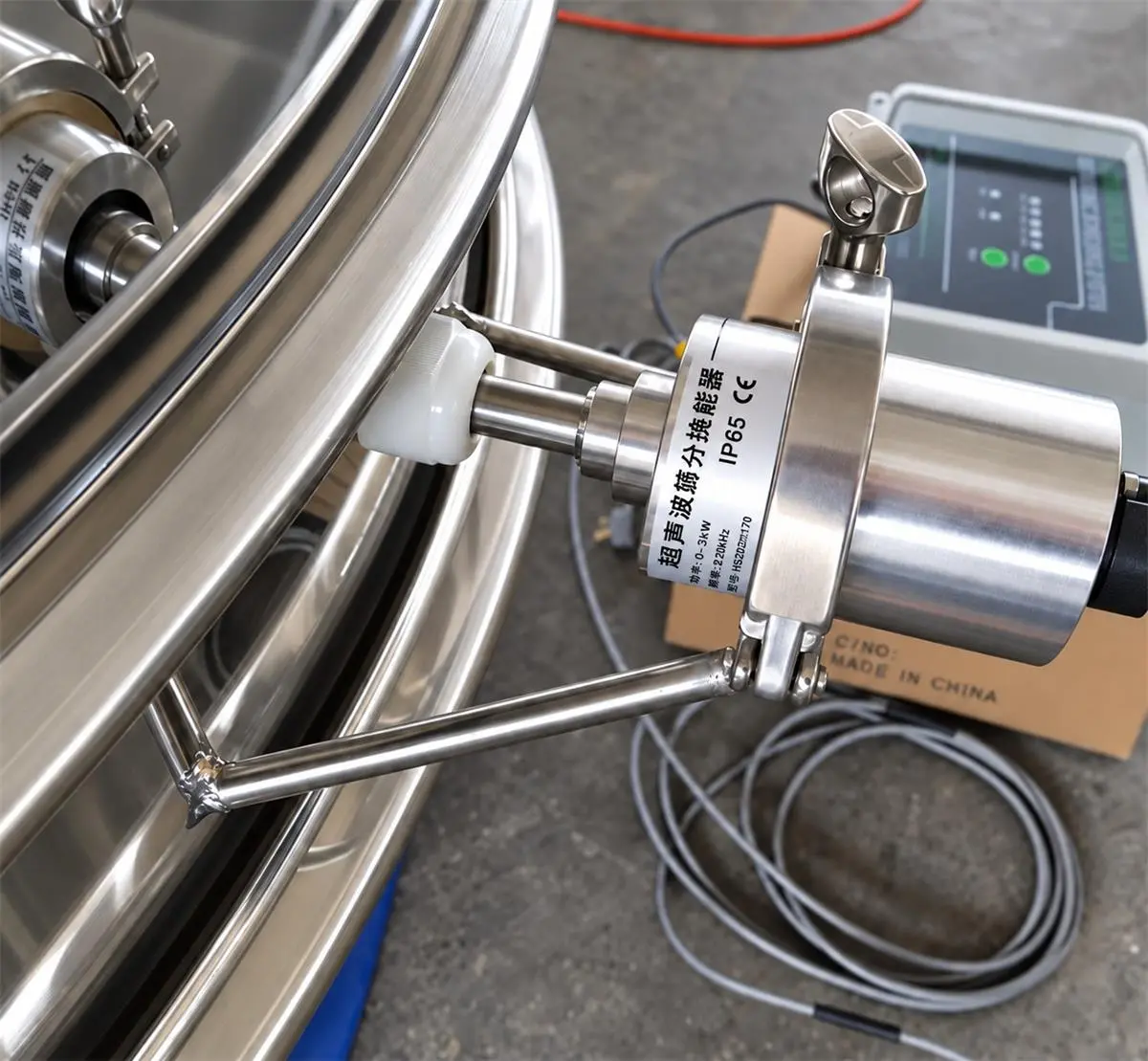
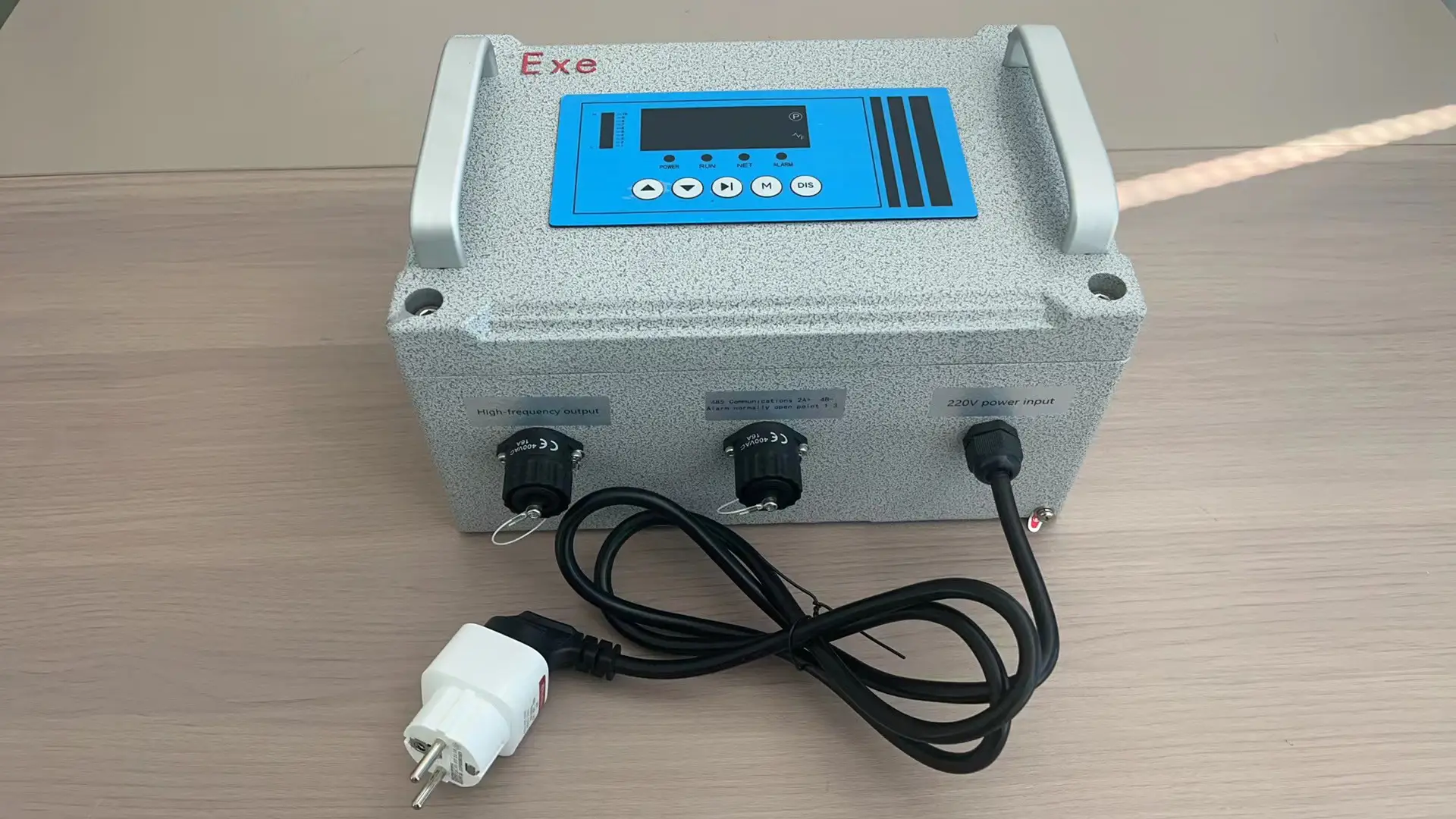
An ultrasonic vibrating screen combines rotary vibration with high-frequency ultrasonic vibration for fine powder screening. The ultrasonic generator operates with a 220V/50Hz or 110V/60Hz power supply, producing a high-frequency electrical signal that the transducer converts into mechanical vibration at approximately 36 kHz (36,000 vibrations per second). This vibration is transmitted to the screen mesh through a resonance ring, while the vibration motor generates three-dimensional material movement across the screen surface. The combined action reduces mesh blinding and particle adhesion, improves screening efficiency, and maintains consistent separation of fine and ultrafine powders.
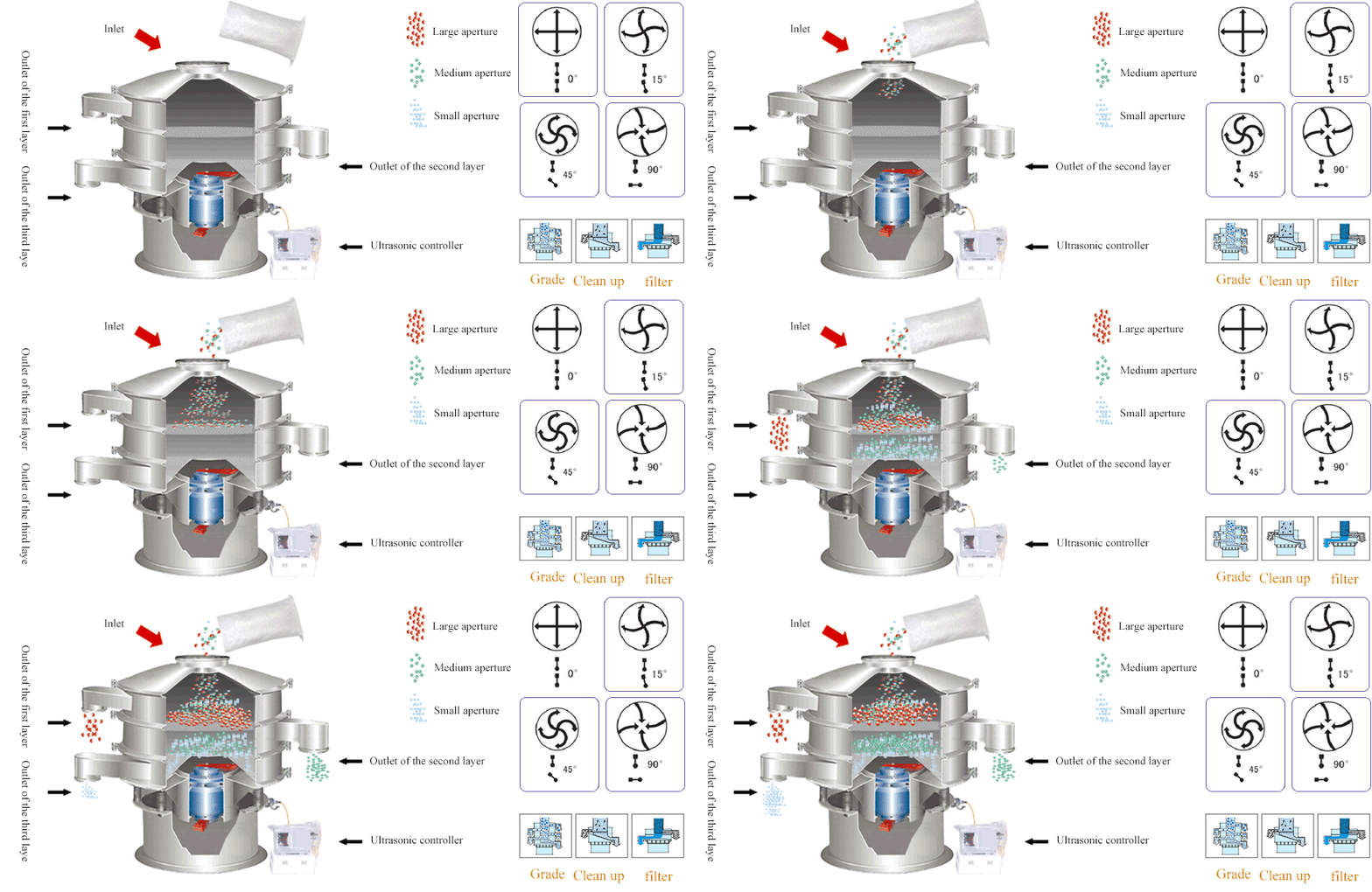
- Feed Distribution: Powder enters through the inlet and spreads across the screen. Uniform feeding limits local overloading and excessive bed depth.
- Rotary Vibration: The vibration motor moves material across the deck. Drive adjustment controls material travel and residence time.
- Ultrasonic Deblinding: The generator drives the transducer, which transmits vibration through the resonant assembly to the mesh. This helps release particles caught in the openings.
- Size Separation: Undersize passes into the lower chamber. Retained material leaves through a separate outlet. Additional decks provide successive size cuts.
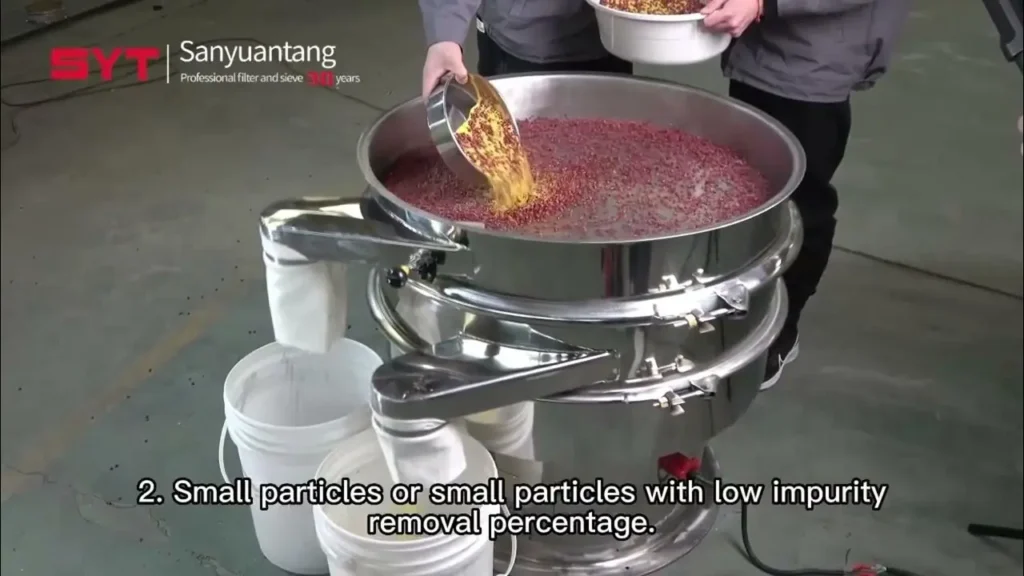
Ultrasonic Vibratory Sieve Testing for Matcha Powder
Ultrasonic Vibrating Screen Structure
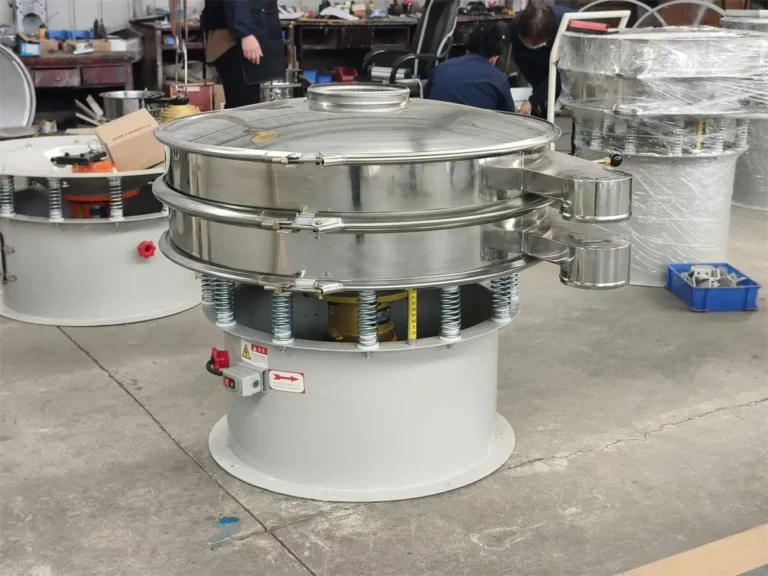
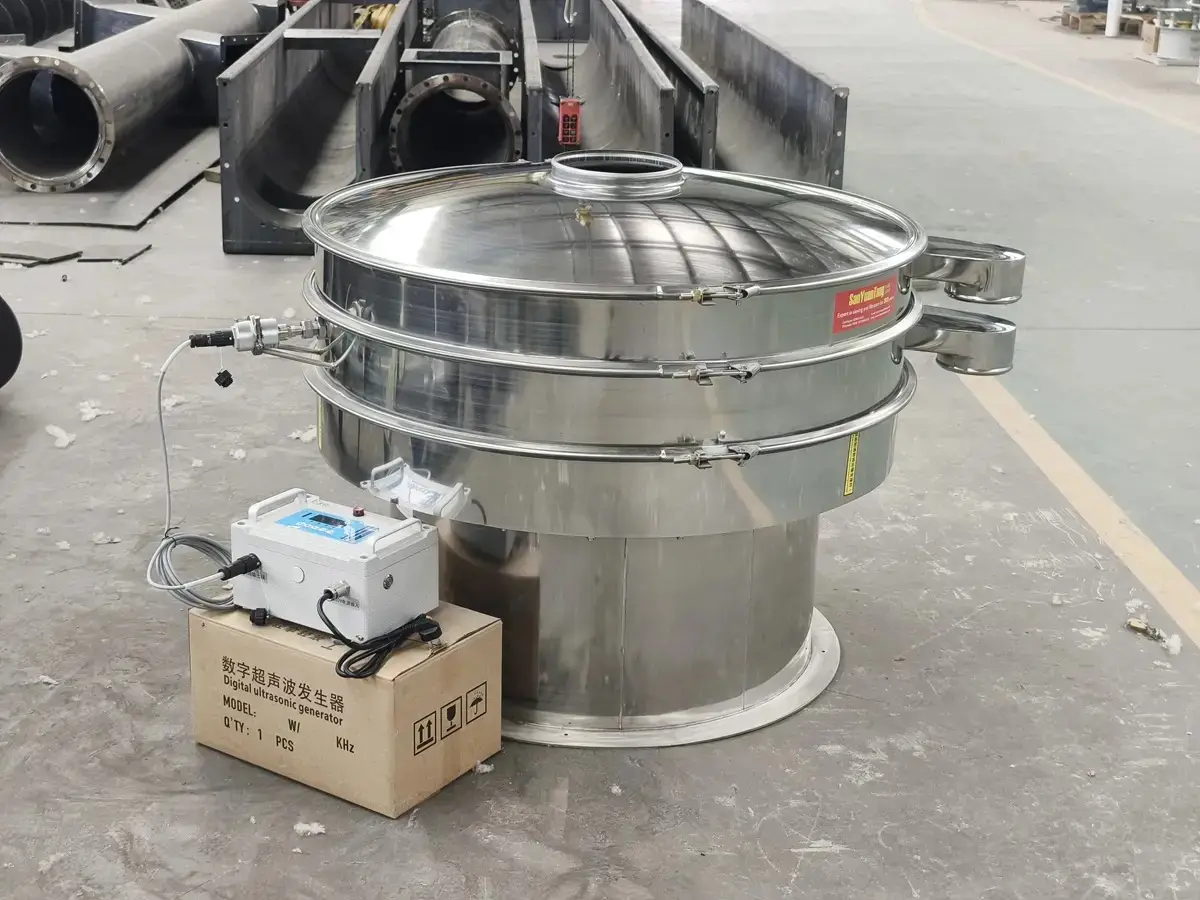
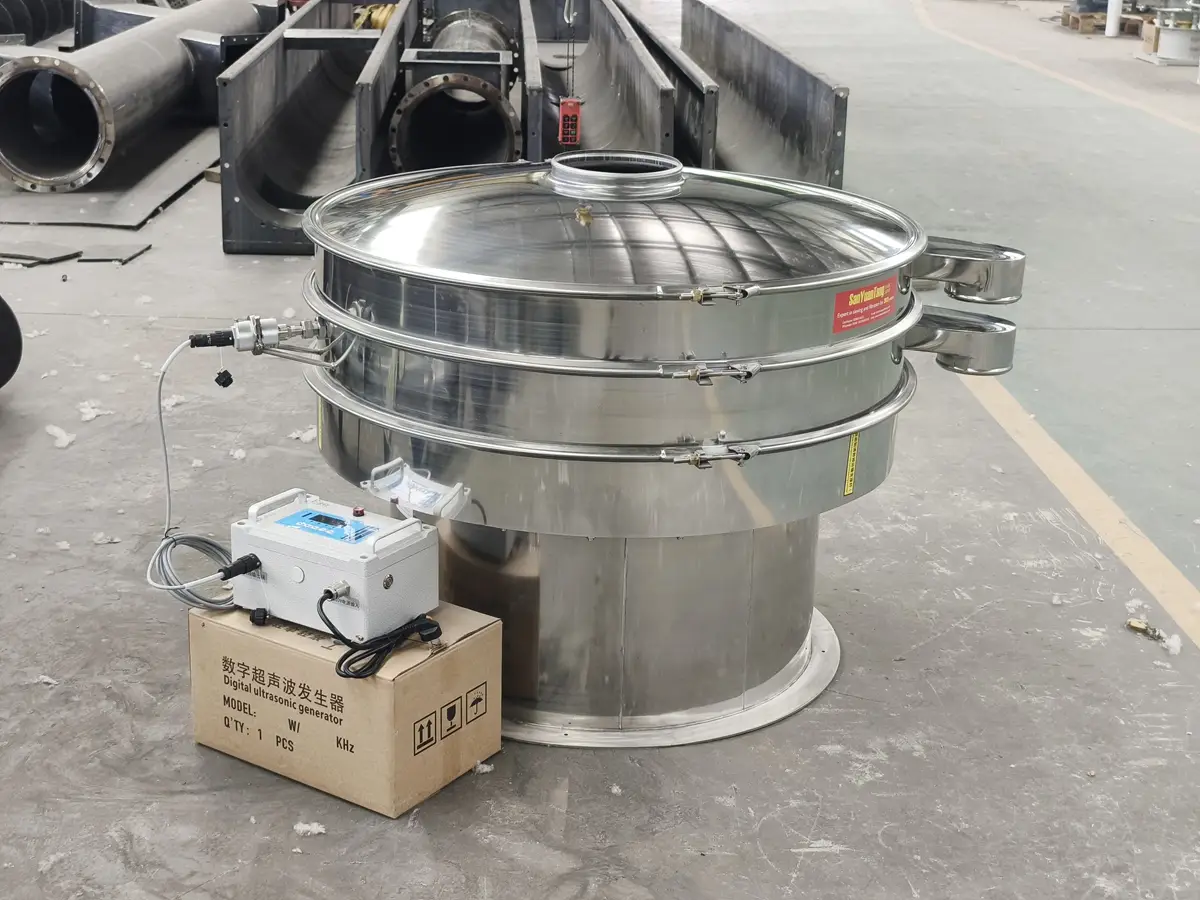
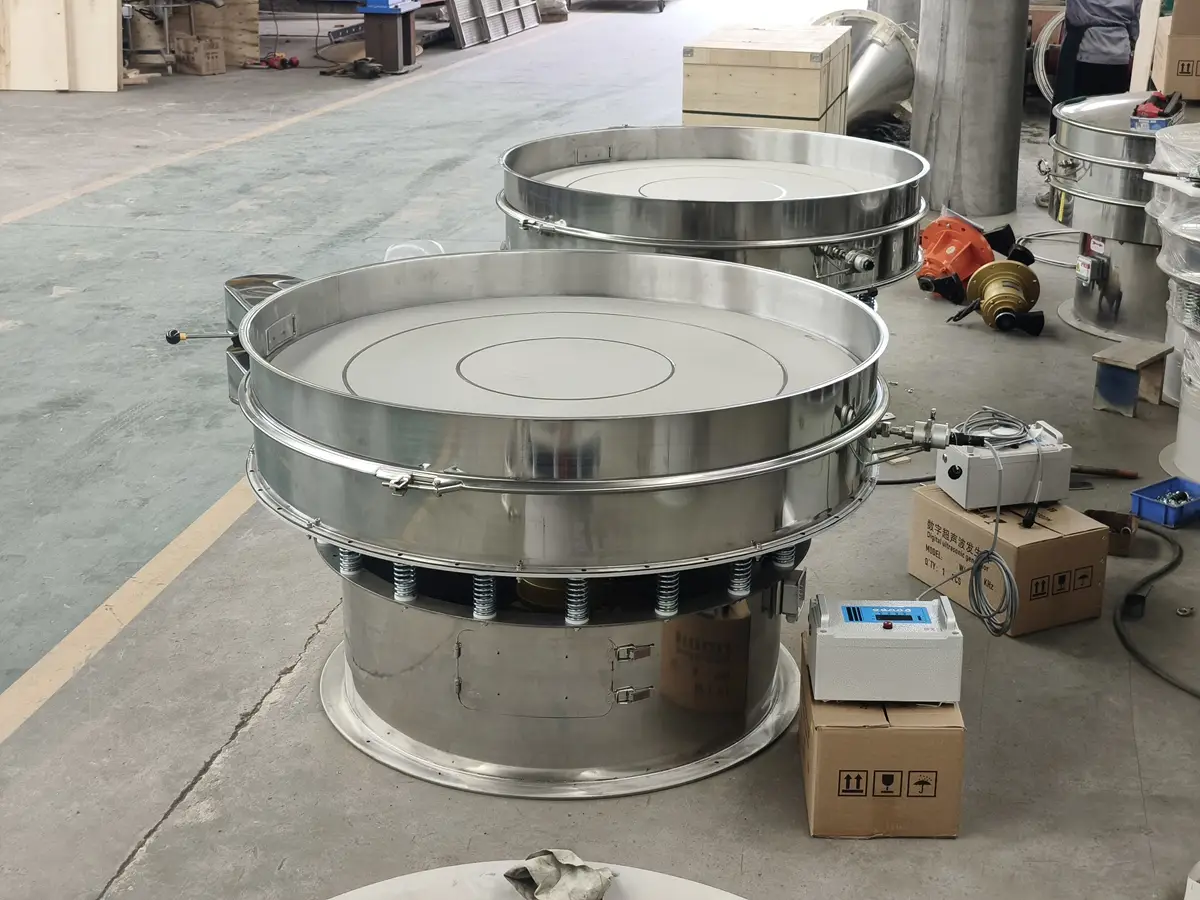
An ultrasonic vibrating screen consists of a screen frame, ultrasonic screen mesh, ultrasonic transducer, ultrasonic generator, vibration motor, damping springs, and discharge outlets. The vibration motor drives material movement and separation, while the ultrasonic system transmits high-frequency vibration to the screen mesh to reduce clogging and improve fine powder screening. The machine also features a sealing system and quick-release clamps for dust containment, easy cleaning, and screen replacement. Sanyuantang offers different screen configurations and contact materials to meet specific powder characteristics, screening requirements, and production conditions.
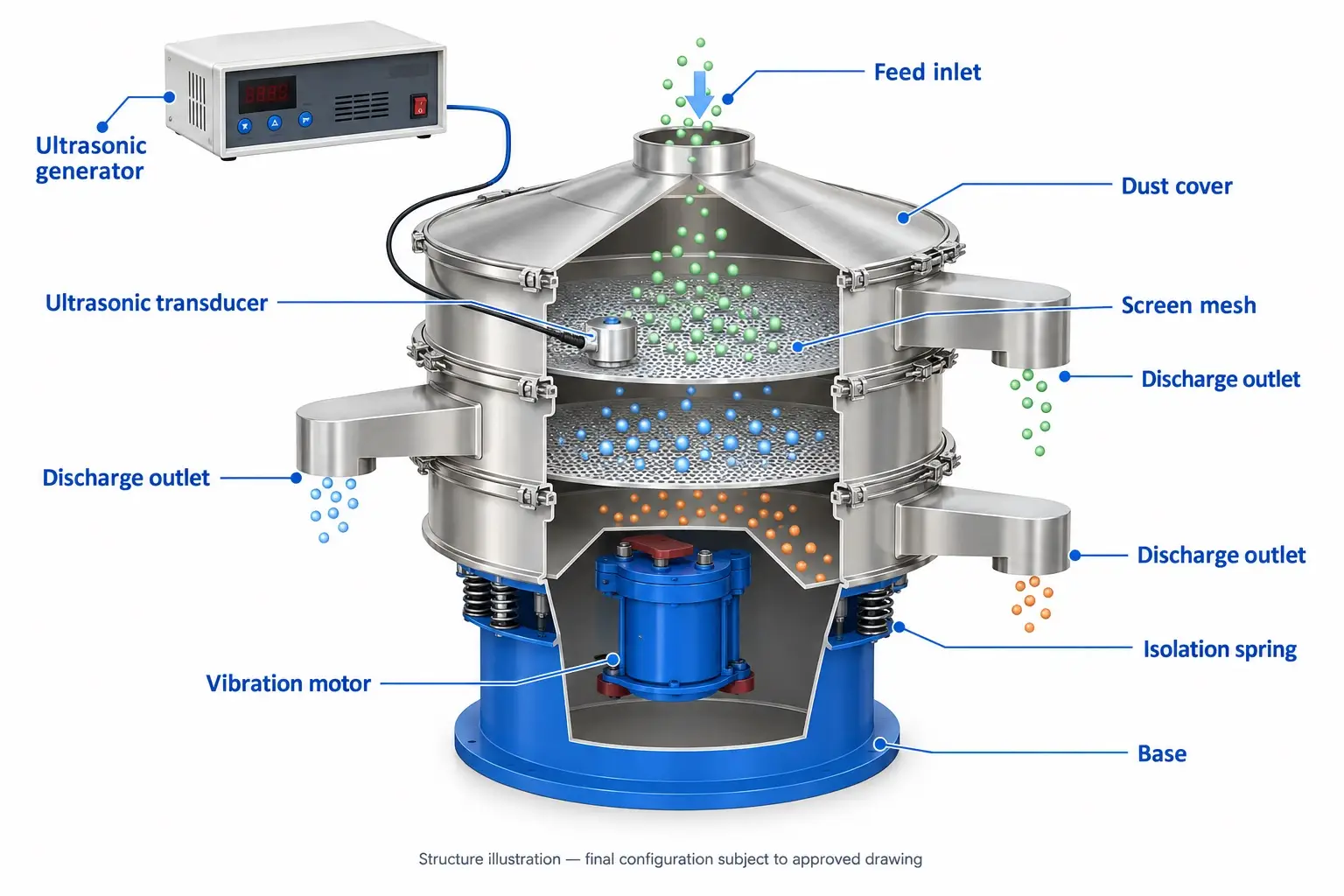
| Component | Features & Functions |
|---|---|
| Ultrasonic Generator | Supplies high-frequency electrical signals, typically 36–38 kHz, to drive the ultrasonic screening system. |
| Ultrasonic Transducer | Converts electrical energy into high-frequency mechanical vibration for fine powder screening. |
| Ultrasonic Resonance Ring | Distributes ultrasonic vibration across the screen mesh to reduce clogging and mesh blinding. |
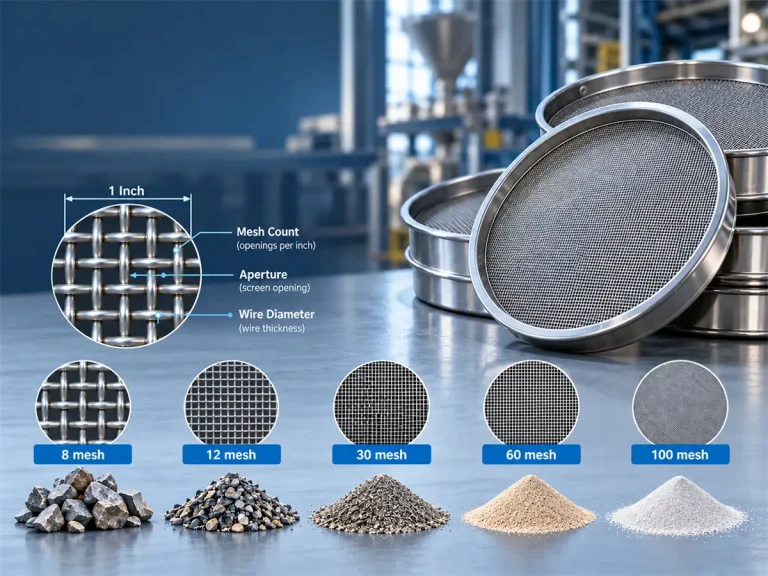
| Ultrasonic Screen Mesh | Supports fine powder classification, with selected configurations reaching 600 mesh depending on material properties. |
| Screen Frame | Holds the screen mesh under tension and allows convenient disassembly for cleaning and replacement. |
| Vibration Motor | Uses adjustable eccentric weights to generate three-dimensional screening motion and control material flow. |
| Screening Chamber | Available with SS304 or SS316L contact surfaces for different material and hygiene requirements. |
| Feed Inlet & Discharge Outlets | Provide continuous material feeding and separate discharge of oversize and undersize particles. |
| Sealing Gaskets & Clamps | Secure the screen assembly, reduce dust leakage, and allow quick access for maintenance. |
| Damping Springs & Base | Support the screening assembly and reduce vibration transmission to surrounding equipment. |
| Ultrasonic Connection Cable | Provides a protected electrical connection between the ultrasonic generator and transducer. |
Specifications
Sanyuantang ultrasonic vibrating screens are available in six standard sizes, with screening diameters from 600 to 1770 mm and motor power from 0.25 to 2.2 kW. Select the appropriate model based on powder characteristics, mesh size, required capacity, and screening stages.
| Model | Screen Diameter (mm) | Screening Area (m²) | Motor Power (kW) | Screen Decks | Packing Dimensions (mm) |
|---|---|---|---|---|---|
| SYC-600 | 600 | 0.28 | 0.25 | 1–5 | 800 × 800 × 680 |
| SYC-800 | 800 | 0.50 | 0.55 | 1–5 | 900 × 900 × 780 |
| SYC-1000 | 970 | 0.74 | 0.75 | 1–5 | 1160 × 1160 × 880 |
| SYC-1200 | 1170 | 1.08 | 1.10 | 1–5 | 1360 × 1360 × 980 |
| SYC-1500 | 1470 | 1.70 | 1.50 | 1–5 | 1850 × 1850 × 1130 |
| SYC-1800 | 1770 | 2.46 | 2.20 | 1–5 | 2200 × 2200 × 1360 |
Custom Ultrasonic Vibrating Screen Configurations
We offer customized ultrasonic vibrating screens to accommodate different material properties, feeding methods, and production line layouts. Scrapers, feeding hoppers, support frames, and inlet designs can be configured according to specific screening requirements.
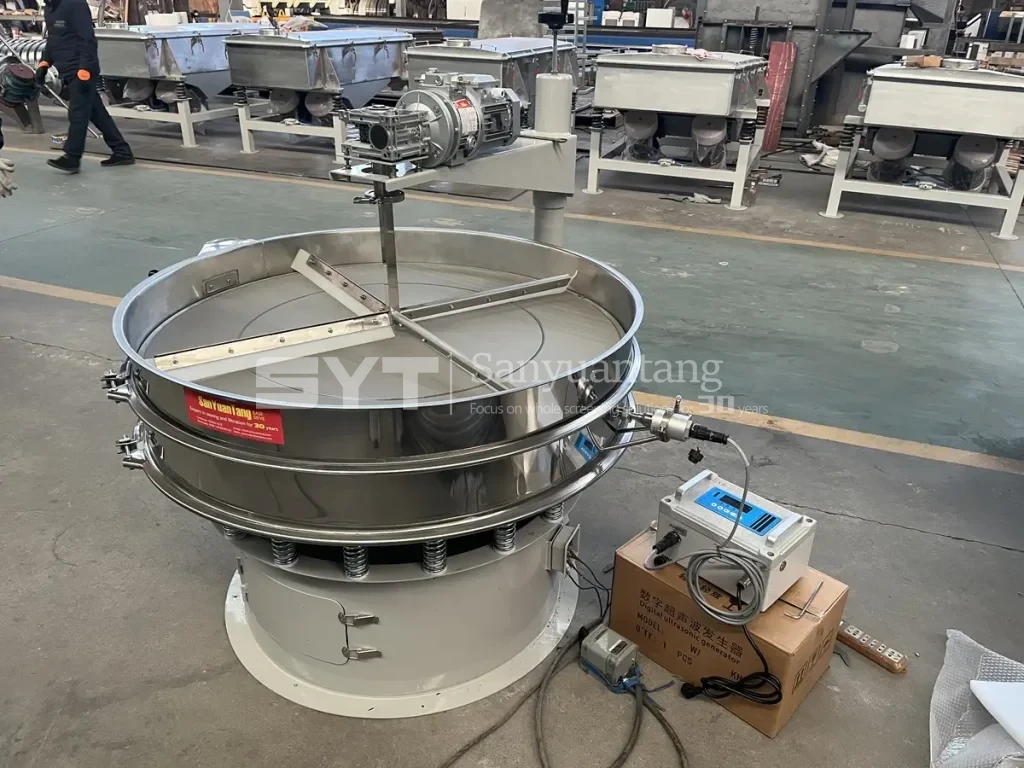
Ultrasonic Vibrating Screen with Scraper
Equipped with a rotating scraper to remove material buildup on the screen surface and improve the discharge of sticky or poorly flowing powders.
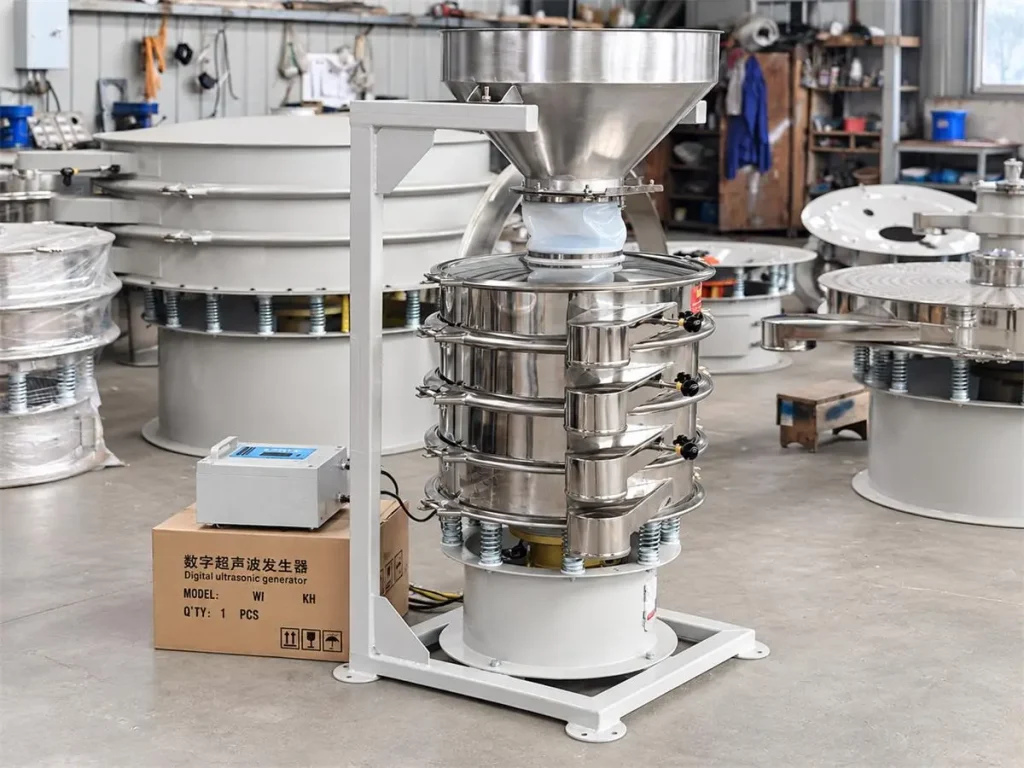
Ultrasonic Vibrating Screen with Feed Hopper
This type features an integrated feed hopper for controlled material feeding and reduced powder spillage.
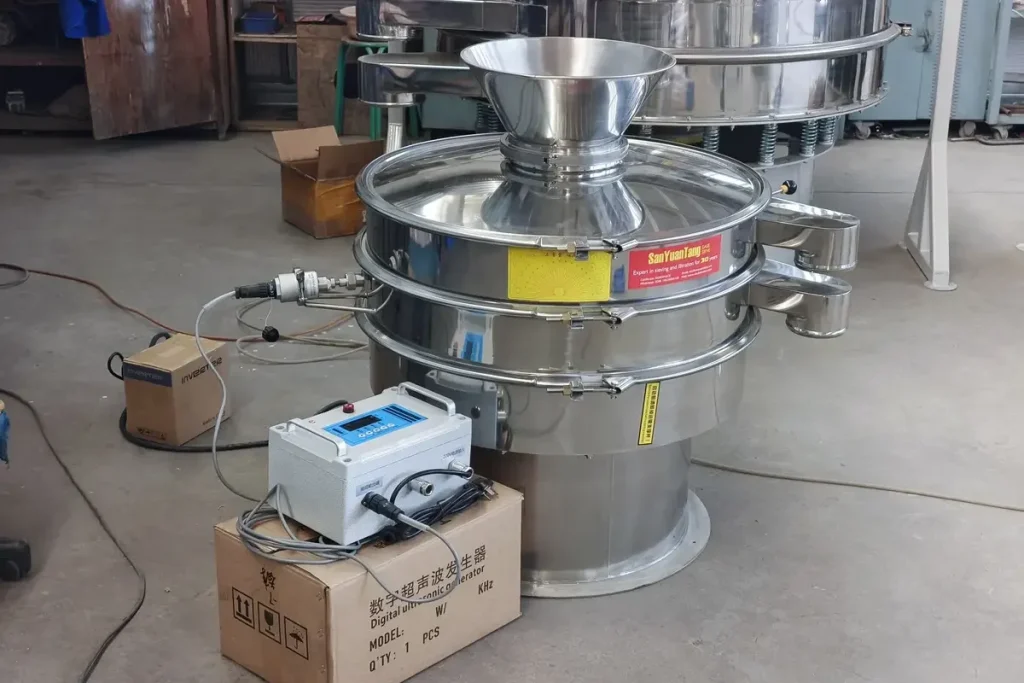
Ultrasonic Vibrating Screen with Custom Feed Inlet
Supports customized inlet sizes, positions, and connections to match existing feeding systems.
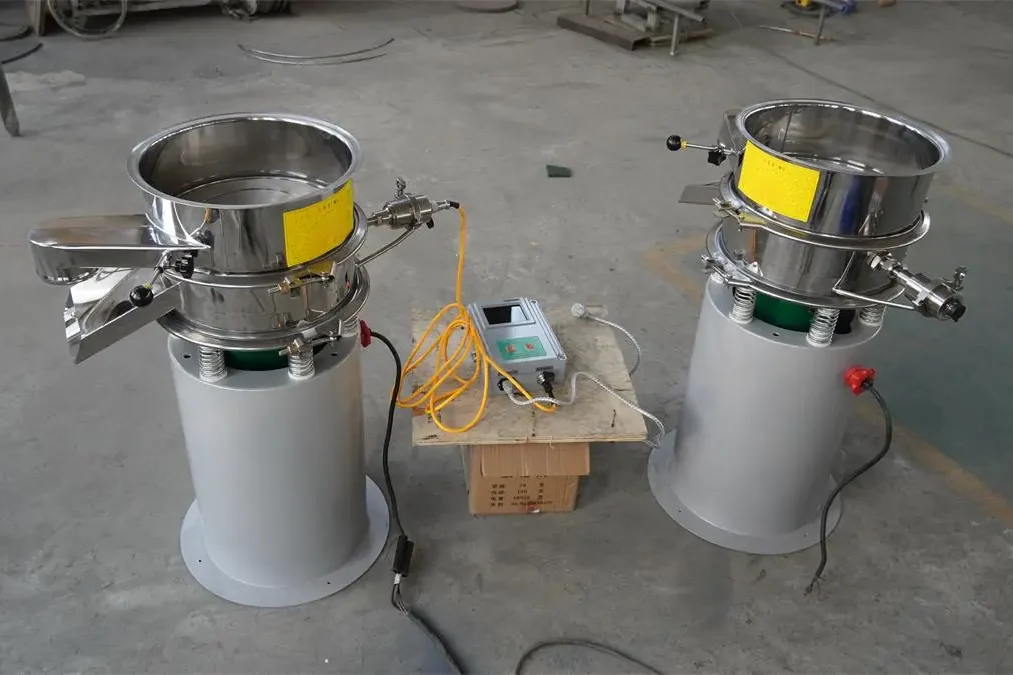
Other Custom Designs
Custom dimensions, screen configurations, and structural designs are available to meet specific production requirements.
Ultrasonic Vibrating Screen Selection Guide
Provide the following data so we can select a screen size, mesh assembly and feeding arrangement for your process.
| Required Information | Details to Provide |
|---|---|
| Material | Powder name, composition, bulk density, moisture and temperature |
| Feed particle size | Sieve analysis or particle size distribution, including the near-size fraction where available |
| Throughput | Required accepted-product kg/h and operating hours per day |
| Target separation | Aperture in μm, required fractions and acceptable off-size material |
| Current screening problem | Mesh blinding, declining output, cleaning frequency or fines lost in the oversize |
| Installation | Available space, feed height, discharge connections and maintenance clearance |
| Construction and services | Contact grade, cleaning method, power supply and dust-control requirements |
Material Testing and Performance Evaluation
For uncertain powder duties, we recommend a representative material trial. The test records the feed condition, installed aperture, equipment setup, run duration and accepted-product output. Product particle size and usable fines in the reject are checked alongside mesh buildup and cleaning interventions. Conventional and ultrasonic comparisons use the same material, aperture and sampling method.
Contact Us
Need Help Choosing the Right Screen Mesh?
Send us your powder type, feed particle size distribution, target aperture and required kg/h. Our engineers can review the mesh assembly, screen area and ultrasonic configuration.
Get Mesh Configuration Advice
Advantages
Fine Powder Screening
Suitable for fine and ultrafine powders, including materials with strong adhesion, high static charge, and poor flowability.
Reduced Mesh Blinding
High-frequency ultrasonic vibration helps prevent fine particles from blocking screen apertures, reducing manual mesh cleaning.
Higher Screening Efficiency
Improves powder passage through fine mesh screens, increasing effective screening capacity and reducing material retention.
Consistent Particle Separation
Maintains stable screening performance and improves particle size classification by minimizing mesh blockage during operation.
Longer Screen Mesh Service Life
Reduces the need for mechanical mesh cleaning, helping minimize screen damage and replacement frequency.
Easy Cleaning & Maintenance
Removable screen frames, quick-release clamps, and accessible components simplify mesh replacement and routine cleaning.
Ultrasonic Vibrating Screen vs. Standard Vibro Sifter
Both machines use circular vibration for material movement and particle separation. An ultrasonic screen adds high-frequency mesh excitation for powders that blind conventional mesh. The choice depends on the source of the screening restriction.
| Selection Factor | Standard Vibro Sifter | Ultrasonic Vibrating Screen |
|---|---|---|
| Screening drive | Circular mechanical vibration | Circular vibration plus ultrasonic mesh excitation |
| Typical duty | General grading and oversize removal | Fine-mesh duties affected by particle lodging or adhesion |
| Mesh cleaning | Conventional cleaning arrangement | Matched ultrasonic deblinding system |
| Selection priority | Required cut, material flow and screen area | Required cut, blinding behaviour and ultrasonic assembly compatibility |
| Maintenance | Mesh, frame, seals and drive | Standard checks plus transducer, generator and connections |
For free-flowing powders with stable mesh passage, our industrial vibro sifter may meet the duty. Where output falls as the mesh blinds, we recommend a comparison at the same aperture and feed conditions.
Ultrasonic Screening Line Integration
Sanyuantang supplies ultrasonic screens for standalone operation and enclosed powder processing lines. Our team reviews feeding stability, equipment elevations, outlet connections and access for screen removal with the line layout.
| Equipment | Function |
|---|---|
| Feed hopper and metering feeder | Supply powder at a controlled rate and limit feed surges. |
| Ultrasonic vibrating screen | Separate powder at the specified aperture and discharge each fraction separately. |
| Flexible connections and collection hoppers | Connect the moving screen to downstream equipment and receive the separated products. |
| Packing or process equipment | Receive screened powder for the next production stage. |
| Plant dust collection | Control dust at the specified transfer and discharge points. |
Covers and sealed connections are coordinated with plant dust control. Pressure containment and explosion protection require a separately defined equipment scope. Share the layout through our powder processing systems service.
Custom Ultrasonic Screening Solutions
We customize the screen arrangement and mechanical interfaces to suit the material and production layout. Our engineers review the screening duty before specifying the ultrasonic assembly and contact construction.
- Screen Size: Select the screen area for the required output, aperture and available space.
- Mesh Assembly: Specify aperture, wire material, resonant frame and compatible ultrasonic components.
- Screen Decks: Configure separation stages, material routing and ultrasonic-assisted decks.
- Contact Materials: Select 304 or 316 stainless steel, seals and finish for the process.
- Feed and Discharge: Match connection sizes, outlet positions and discharge height to the line.
- Support Arrangement: Review raised or mobile configurations, working position and maintenance access.
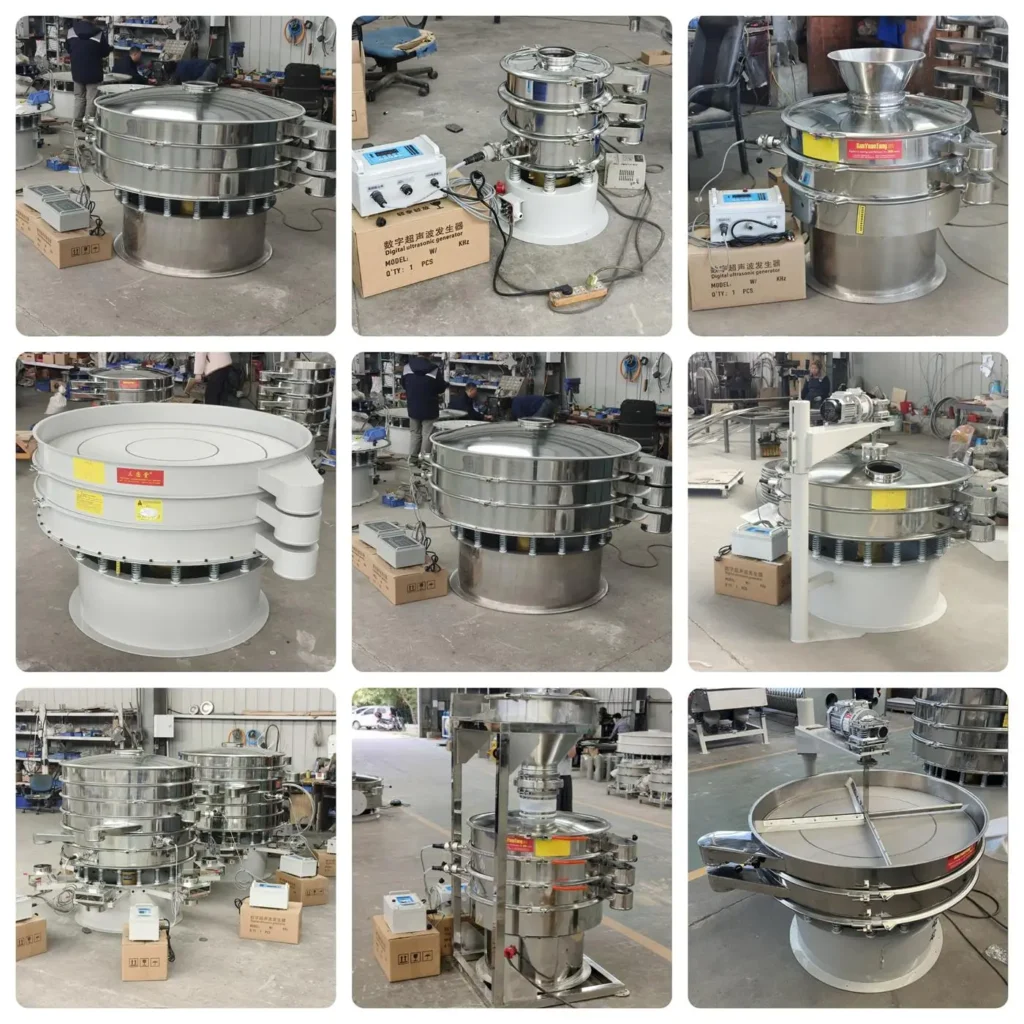
Ultrasonic Vibrating Screen Manufacturer & Supplier
Sanyuantang (Xinxiang Sanyuantang Machine Co., Ltd.) is an experienced manufacturer of industrial screening equipment, specializing in fine powder sieving, particle classification, and production line integration. With over 30 years of industry experience, we combine in-house equipment manufacturing, engineering design, and quality inspection to supply ultrasonic vibrating screens for pharmaceutical, food, chemical, metal powder, and battery material processing.
Beyond standard machines, we provide customized ultrasonic screening solutions, including screen mesh selection, stainless steel contact parts, ultrasonic systems, feeding and discharge configurations, and connections to existing production lines. Our engineers evaluate material properties, screening accuracy, and required throughput to recommend suitable equipment. From technical consultation and machine customization to installation guidance, spare parts, and after-sales support, Sanyuantang helps customers establish reliable industrial powder screening operations.
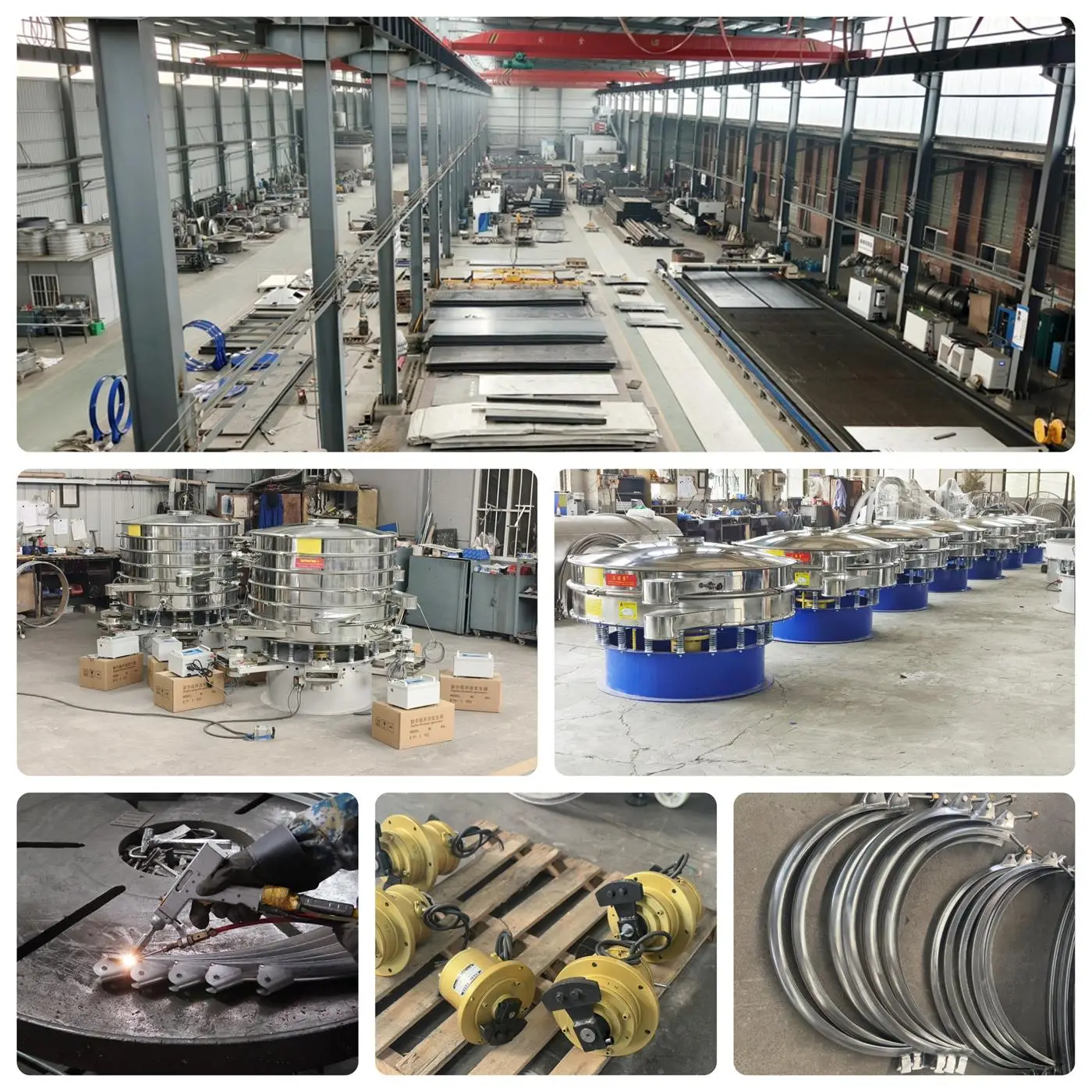
Our Manufacturing & Engineering Services
- Equipment Configuration: Screen size, deck arrangement, contact parts and inlet/outlet interfaces for the selected duty.
- Material Testing and Selection: Mesh and capacity evaluation using representative feed and agreed separation criteria. Trial scope and reporting are confirmed for the application.
- Screening Line Integration: Review of metered feeding, screening, fraction collection and downstream connections.
- Technical Documentation and Spare Parts: Drawings, operating instructions and matched replacement assemblies according to the order scope.
Learn more about our manufacturing capabilities and technical services.
Contact Us
Request an Ultrasonic Vibrating Screen Quote
Send your material, target aperture, required capacity and current screening problem. Our team will review the screen size, ultrasonic system and connections for your application.
Send Your Powder Screening Requirements
FAQs
What mesh sizes can an ultrasonic vibrating screen handle?
An ultrasonic vibrating screen typically handles 10–635 mesh (2,000–20 μm), depending on powder characteristics, screen mesh configuration, and required screening capacity.
Does ultrasonic screening increase output for every powder?
No. Ultrasonic screening can improve throughput for fine, cohesive, or mesh-blinding powders, but actual performance depends on particle size, moisture content, material flowability, and screen mesh configuration.
Can one machine produce several powder grades?
Yes. An ultrasonic vibrating screen with multiple screen decks can separate powders into several particle size grades in one operation, depending on the mesh configuration and material properties.
Can an ultrasonic system be fitted to an existing screen?
Yes. An ultrasonic screening system can be retrofitted to an existing vibrating screen, provided the screen frame, mesh assembly, and machine structure are compatible with the ultrasonic components.
Can ultrasonic vibration break hard lumps?
No. Ultrasonic vibration helps break up soft powder agglomerates and prevent mesh blinding, but hard lumps generally require crushing or milling before screening.
What information is needed for a quotation?
Provide the powder name, feed particle size distribution, target aperture and required accepted-product kg/h. Include bulk density, moisture, contact material, power supply and the line layout where available. Existing machine and mesh details help us assess a replacement or retrofit.