
Sanyuantang provides pharmaceutical screening, powder conveying, feeding, and mixing solutions for active pharmaceutical ingredients (APIs), excipients, medicinal powders, and granules. Our equipment is used for raw material check screening, fine powder separation, granule classification, and powder transfer between production stages.
We select and configure equipment based on material properties, target particle size, processing capacity, and cleaning requirements. From standalone pharmaceutical sifters to integrated conveying and screening systems, we help customers build practical equipment arrangements for their production lines.
On this page: Materials · Challenges · Applications · Equipment · Process systems · Design and cleaning · Project and test data · Selection · FAQs
Pharmaceutical Materials We Process
Pharmaceutical materials vary in particle size, density, moisture content, and flowability. Fine powders may cling to the screen surface, while granules need controlled separation to remove oversized particles and fines. We select screening and handling equipment according to the characteristics of each material and its processing requirements.
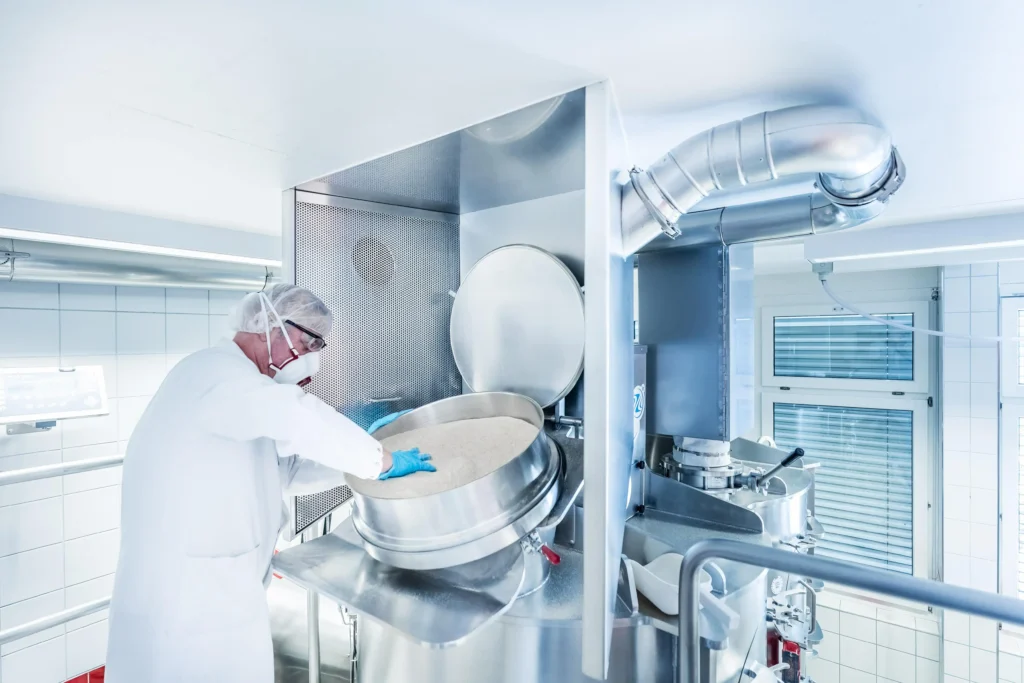
Active Pharmaceutical Ingredients (APIs)
API powders and pharmaceutical intermediates often require fine screening to remove agglomerates and oversized particles before further processing. Some materials are lightweight, cohesive, or prone to static buildup, making them difficult to screen through fine mesh.
We use rotary vibrating screens and ultrasonic screening systems depending on the required particle size, feed rate, and powder behavior.
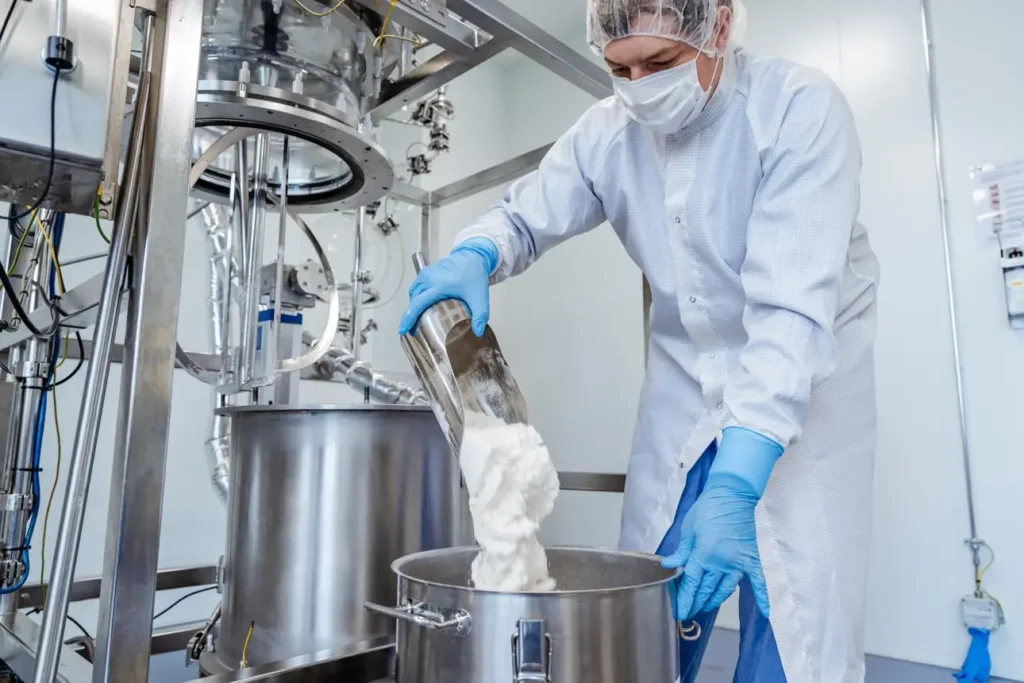
Pharmaceutical Excipients
Common excipients include lactose, starch, mannitol, sorbitol, magnesium stearate, and calcium phosphate. These materials are often screened before blending to remove lumps and provide a more consistent feed to downstream equipment.
A vibro sifter or inline sifter can be used for routine check screening, while finer or more cohesive powders may require additional screen-cleaning assistance.
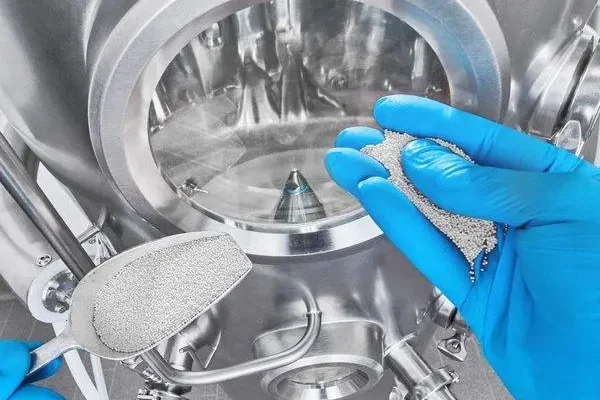
Pharmaceutical Granules & Pellets
Granules produced during wet or dry granulation may contain oversized pieces and unwanted fines. Screening helps separate these fractions before subsequent processing, such as blending, tablet compression, or capsule filling.
We configure single- or multi-deck vibrating screens according to the required particle size range and the handling characteristics of the granules.
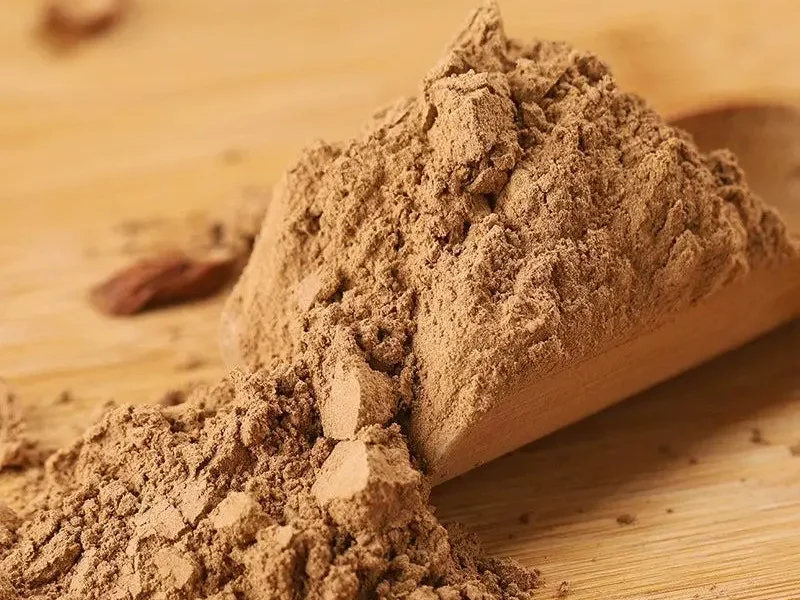
Herbal Medicine Powders
Herbal powders and traditional medicinal materials may contain fibrous particles, coarse fragments, and agglomerates after grinding. Their screening behavior varies with fiber content, moisture, and particle shape.
Sanyuantang supplies vibrating screening equipment for removing oversized material and classifying herbal powders. Screen opening and machine configuration are selected according to the material being processed.

Vitamins & Nutraceutical Powders
Vitamins, mineral blends, and nutritional powders may require screening before mixing, filling, or packaging. Some formulations flow freely, while others form lumps or adhere to fine mesh.
We use material screening tests to determine suitable screen openings and machine configurations for these powders.
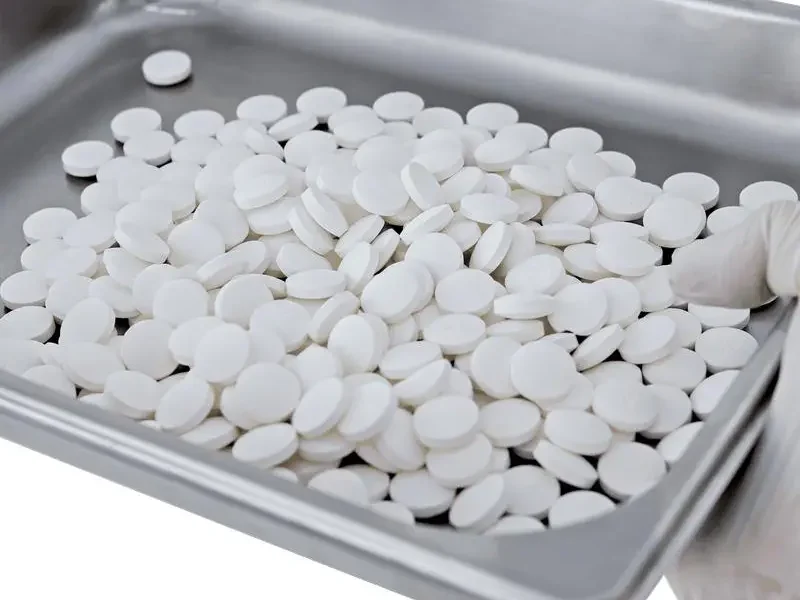
Tablets & Medicinal Pellets
Some finished tablets and medicinal pellets require the removal of loose powder, broken pieces, or undersized particles during handling.
Depending on product size, strength, and surface characteristics, suitable screening or separation equipment can be considered. Fragile or coated products require particular attention to handling intensity and potential damage.
Common Challenges in Pharmaceutical Powder Screening
Pharmaceutical powders vary in particle size, flowability, and moisture content. Fine powders may clog the screen, while granules and excipients can contain lumps or oversized particles. These problems can affect screening capacity, particle size consistency, and downstream processing.
Pharmaceutical Screening Applications
Screening equipment is used at different stages of pharmaceutical production. The screening method depends on whether the process needs to remove lumps, control particle size, separate fines, or prepare materials for the next operation.
Raw Material Check Screening
Raw material check screening is commonly performed before blending, granulation, or other processing stages. Its main purpose is to remove lumps and oversized material that may have formed during storage, transportation, or handling.
For materials such as lactose, starch, and mannitol, a rotary vibrating screen or inline sifter can provide continuous screening as powder enters the process.
We select the screen opening according to the acceptable particle size range, rather than simply using the finest available mesh.
Fine API Powder Screening
Fine API powders can be difficult to screen because of their small particle size, low bulk density, or tendency to adhere to the mesh. As the screen opening becomes smaller, maintaining a consistent feed rate and preventing blockage become more important.
A rotary vibrating screen is suitable for many general fine-powder applications. For powders that repeatedly blind the screen, an ultrasonic vibrating screen may improve material passage by applying high-frequency vibration to the mesh.
We assess the actual powder behavior, target mesh, and required throughput before recommending the screening method.
Pharmaceutical Granule Classification
After granulation and drying, pharmaceutical granules may contain oversized pieces, acceptable granules, and fine powder.
A multi-deck vibrating screen can divide the material into different size fractions. For example, the upper screen removes oversized granules, while the lower screen separates fines. The material retained between the two screens forms the selected particle size fraction.
This arrangement is useful where granule size distribution must be controlled before blending, tablet compression, or capsule filling.
For common pharmaceutical granule applications, screen openings in the 16–80 mesh range may be considered, depending on the product specification.
Tablet Dedusting & Pellet Screening
Tablets and medicinal pellets may carry loose surface powder or contain broken pieces after production and handling. Separation equipment can help remove these unwanted fractions before collection or packaging.
The machine must be selected with the product’s size, shape, and mechanical strength in mind. For finished tablets requiring controlled handling, a dedicated tablet deduster may be more appropriate than a general-purpose vibrating screen.
For medicinal pellets and more robust granular products, we can evaluate suitable low-impact screening arrangements through material testing.
Screening & Powder Handling Equipment for Pharmaceutical Production
Sanyuantang supplies screening, feeding, conveying, and mixing equipment for different stages of pharmaceutical powder processing. We recommend equipment based on its function within the production line, available installation space, and the properties of the material.
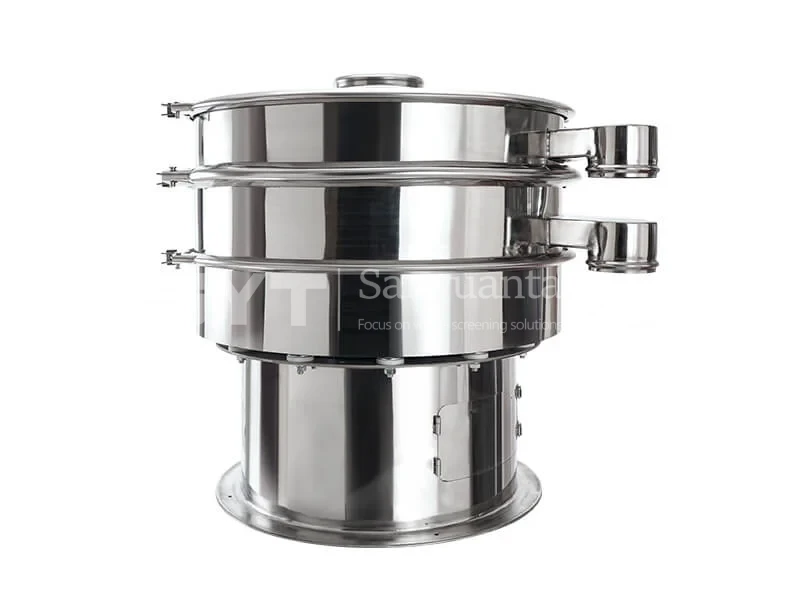
Rotary Vibrating Screen / Vibro Sifter
A rotary vibrating screen is widely used for powder check screening, impurity removal, and granule classification. Its circular screen deck can be fitted with different mesh openings, and multi-deck configurations allow separation into several particle size fractions.
Suitable for: Pharmaceutical excipients, general medicinal powders, herbal powders, and granules.
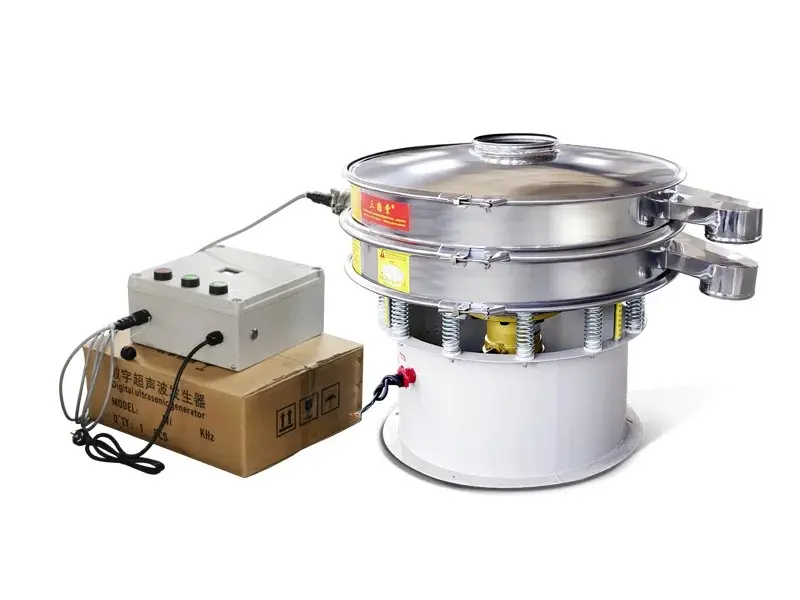
Ultrasonic Vibrating Screen
An ultrasonic vibrating screen combines conventional vibration with high-frequency ultrasonic energy applied to the mesh. This helps reduce screen blinding when processing fine powders that tend to stick or accumulate on the screen surface.
Suitable for: Fine APIs, cohesive medicinal powders, and other difficult-to-screen materials.
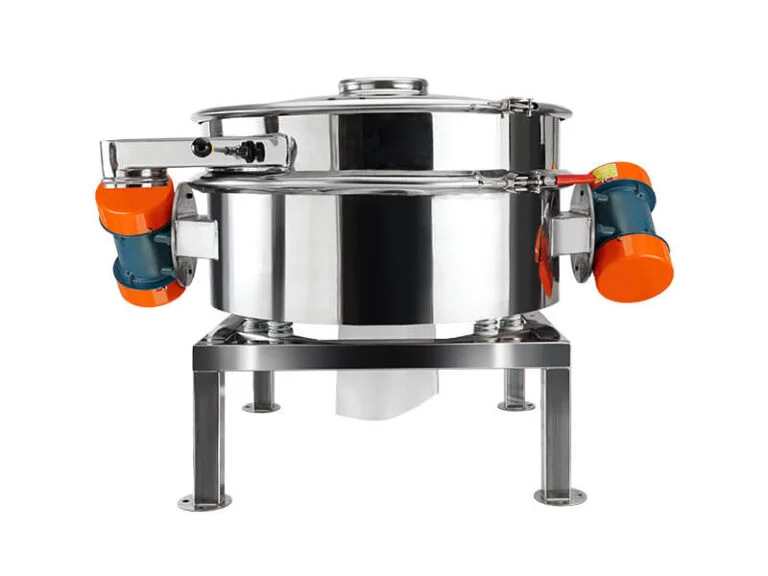
Inline Sifter
An inline sifter provides check screening in a compact arrangement and can be connected to existing feeding or discharge points. It is useful where material needs to pass through a screen before entering the next processing stage.
Suitable for: Powder check screening, granule separation, and continuous production lines with limited installation space.
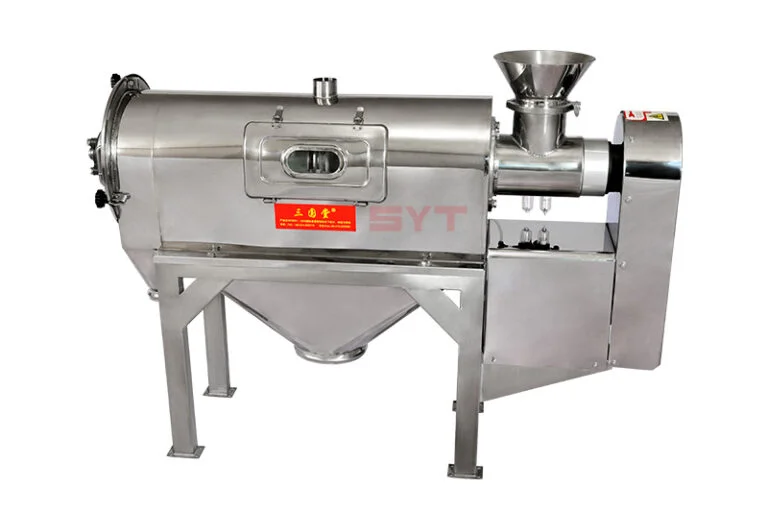
Centrifugal Sifter
A centrifugal sifter uses a rotating internal assembly to move powder through a cylindrical screen. It can be considered for certain lightweight powders and materials containing soft agglomerates.
Suitable for: Selected free-flowing or moderately cohesive powders, subject to material testing and the required separation.
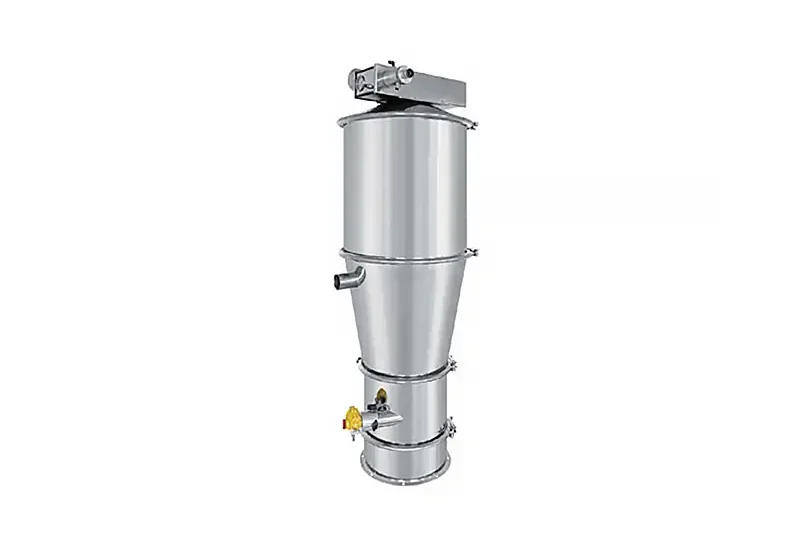
Vacuum Conveyor & Powder Feeder
Vacuum conveying equipment transfers powders between hoppers, screening machines, mixers, and storage vessels through enclosed pipework. Feeders can also provide controlled material delivery to downstream equipment.
Suitable for: Powder transfer, enclosed feeding, and reducing manual handling between production stages.
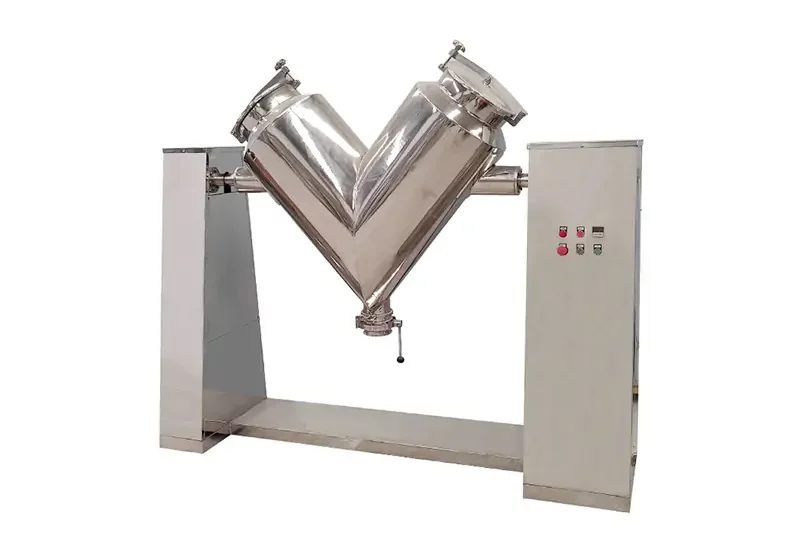
Pharmaceutical Powder Mixer
Powder mixers are used to blend screened ingredients before subsequent pharmaceutical processing. Sanyuantang offers mixing equipment that can be arranged with upstream feeding and screening equipment.
Suitable for: Pharmaceutical excipients, medicinal powders, and other formulations requiring batch blending.
Explore the screening equipment range and powder feeding equipment, or discuss your equipment arrangement.
Pharmaceutical Powder Conveying & Screening Systems
Pharmaceutical powder production often involves several connected operations, including raw material feeding, conveying, screening, mixing, and collection. Handling powder manually between each stage increases transfer time and creates more opportunities for dust release and material loss.
Sanyuantang provides equipment arrangements that connect these operations according to the customer’s production process.
A typical powder handling arrangement may include:
Bag Dump Station
Receive bagged raw materials with dust-controlled feeding.
Vacuum Conveyor
Transfer powder through enclosed pipework to the screening stage.
Vibrating Sifter
Remove oversized particles or separate the required fractions.
Mixer or Collection Hopper
Collect accepted powder or transfer it to the next process.
The equipment sequence can be adjusted depending on whether screening is required before mixing, after granulation, or at the final product handling stage.
API Powder Conveying & Screening System
For fine API powders, enclosed transfer and stable feeding are important parts of the screening process.
A dust-controlled bag dumping station receives the raw material, while a vacuum conveying system transfers it to the vibrating sifter. The screen removes unwanted oversized material before the accepted powder is collected or transferred to the next process.
Where the material is prone to mesh blockage, the vibrating sifter can be evaluated with an ultrasonic screening system.
We configure the conveying route, screen size, material-contact components, and discharge arrangement around the customer’s production capacity and plant layout.
Pharmaceutical Granule Screening Line
Granule screening systems are commonly installed after granulation and drying to remove oversized pieces and excessive fines.
A vibrating screen separates the granules into the required particle size fractions, which can then be directed to collection containers, storage hoppers, or downstream equipment.
For multi-grade separation, we can arrange multiple screen decks and discharge outlets. The screening capacity and handling method are selected to avoid excessive material buildup and unnecessary granule breakage.
Hygienic Design & Cleaning Requirements
Equipment used in pharmaceutical powder processing must be suitable for the materials handled and the cleaning procedures used at the production site. Material-contact surfaces, seals, screen assemblies, and discharge connections all need to be considered when selecting a pharmaceutical sifter.
Stainless Steel Contact Parts
Sanyuantang offers stainless steel screening equipment, with material-contact components selected according to the customer’s application.
304 stainless steel is suitable for many general powder handling processes. Where greater corrosion resistance is required, 316 or 316L stainless steel components can be specified subject to the equipment configuration.
We confirm the required contact material, surfac
Easy Cleaning & Screen Replacement
Screens and internal components need regular inspection and cleaning, especially where different products are processed on the same machine. Quick-release clamps, removable screen frames, and accessible product-contact areas can simplify screen replacement and manual cleaning. Seals and discharge connections should also be included in the cleaning procedure. We review the customer’s cleaning method and product changeover requirements when determining the equipment structure.
Enclosed Design & Dust Control
Fine powders can escape through open feeding points and poorly sealed connections. Enclosed screen covers, suitable gaskets, sealed discharge outlets, and connected conveying systems help reduce dust release during operation. For powders requiring a higher level of containment, additional engineering measures may be needed, including dust extraction, pressure control, and suitable operator protection. The final equipment arrangement should match the site’s containment requirements and cleaning validation procedures.
Pharmaceutical Screening Projects & Test Results
Explore our pharmaceutical screening projects and test results to see how different powders and granules are processed, including equipment configurations, screen mesh sizes, and production capacities.
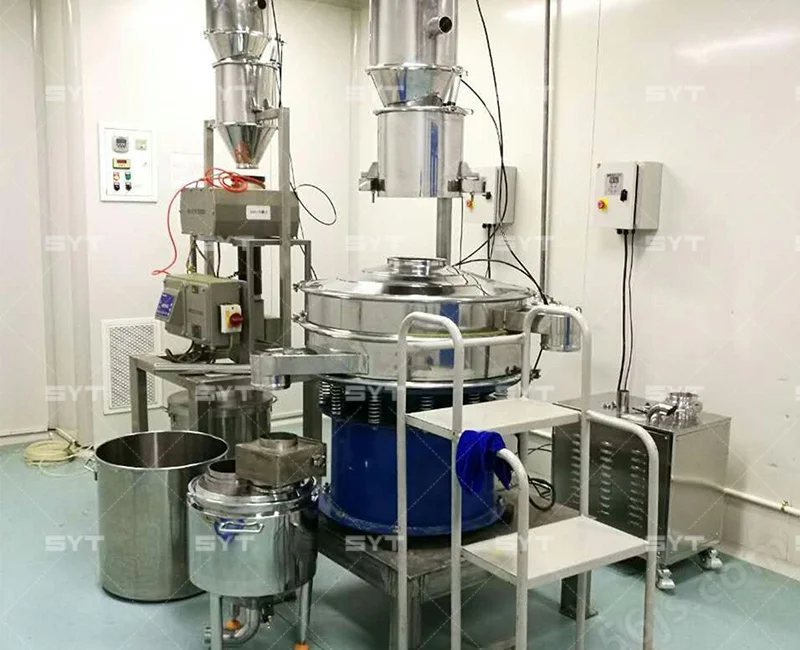
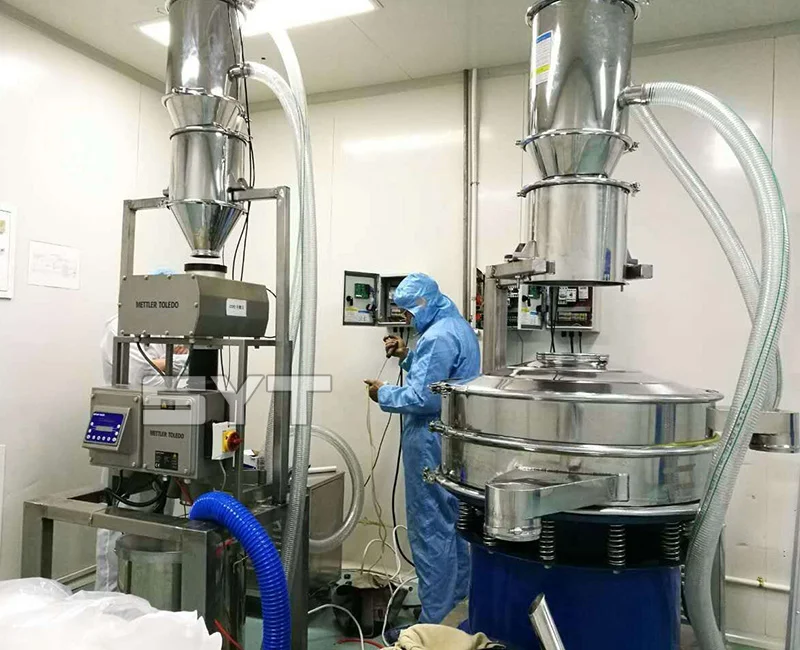
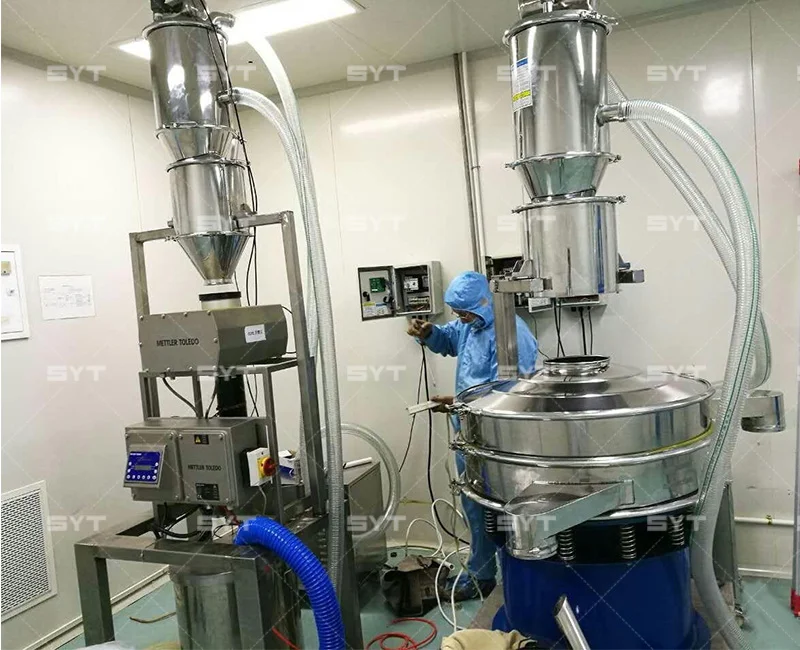
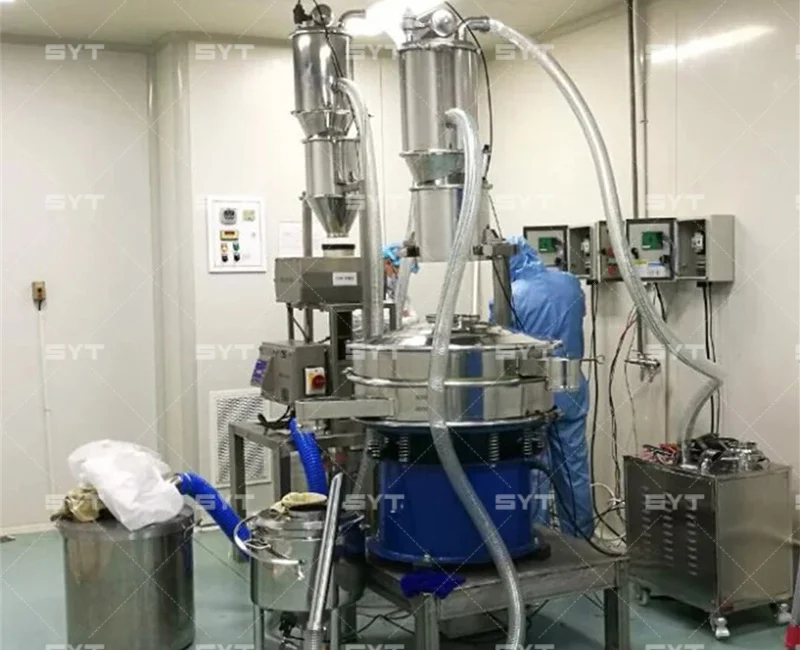
API Powder Screening & Conveying Project
A pharmaceutical manufacturer needed to screen fine API powder at 500 kg/h while reducing mesh blockage and dust during material transfer.
Sanyuantang supplied a rotary vibrating sifter connected to a dust-controlled feeding station and vacuum conveyor. The system combined powder feeding, screening, and enclosed transfer for continuous processing.
Project specifications:
| Project Parameter | Specification |
|---|---|
| Material | API powder |
| Required processing capacity | 500 kg/h |
| Screening mesh range | 16–250 mesh |
| Equipment material | 304 stainless steel |
| Equipment configuration | Rotary vibrating sifter, feeding station, and vacuum feeder |
The system combines powder screening and enclosed conveying to support continuous pharmaceutical raw material processing.
Pharmaceutical Material Sieving Test Data
The following examples are Sanyuantang’s pharmaceutical screening records.
| Material | Screen Mesh | Method | Recorded Capacity | Equipment Model |
|---|---|---|---|---|
| Medicinal powder | 80 mesh | Dry | 550 kg/h | SY-800-2S |
| Nucleotide | 150 mesh | Dry | 2,100 kg/h | SY-1600-2S |
| Panax notoginseng powder | 120 mesh | Wet | 1,300 kg/h | SY-1200-2S |
| Pharmaceutical granules | 40 mesh | Dry | 3,500 kg/h | SYM-1500-1S |
These results are reference examples from individual screening applications. Actual throughput depends on material properties, feed conditions, screen opening, and equipment configuration.
For new materials, we recommend a screening test before confirming the required machine size and production capacity.
How to Choose Pharmaceutical Screening Equipment?
Selecting the right pharmaceutical screening equipment depends on the material, required particle size, and processing capacity. Cleaning requirements, powder flowability, and production line connections should also be considered to ensure the equipment fits the process.
We normally review the following information before recommending equipment.
| Selection Factor | Information Required |
|---|---|
| Material type | API, excipient, medicinal powder, or granule |
| Screening purpose | Check screening, lump removal, fine screening, or classification |
| Particle size | Feed particle size and target mesh or aperture |
| Processing capacity | Required kg/h or batch quantity |
| Powder properties | Bulk density, moisture, flowability, adhesion, and static |
| Contact material | 304, 316, or 316L stainless steel requirements |
| Cleaning requirements | Cleaning method, frequency, and product changeover |
| Installation conditions | Available space, inlet/outlet dimensions, and connected equipment |
For routine check screening, a rotary vibrating screen or inline sifter is often a practical starting point. For fine powders that clog the mesh, an ultrasonic vibrating screen may be more suitable. Where several particle size fractions are required, a multi-deck vibrating screen can be considered.
We can review material samples and screening requirements to help determine the mesh opening, screen diameter, number of decks, and suitable feeding arrangement.
Custom Pharmaceutical Screening Solutions from Sanyuantang
Sanyuantang provides customized screening, feeding, conveying, and mixing equipment for pharmaceutical powder and granule processing. We select machine sizes, screen mesh, contact materials, and equipment connections according to the material properties, production capacity, and cleaning requirements.
Material Screening Tests
We evaluate the material’s screening behavior, target mesh, and required throughput to help determine a suitable screening method.
Equipment and Material Customization
Screen size, number of decks, inlet and outlet arrangements, contact materials, and other equipment details can be configured for the application.
Conveying and Feeding Integration
We can connect screening equipment with feeding stations, vacuum conveyors, collection hoppers, and mixing equipment according to the production process.
Production Line Layout Support
Our team reviews equipment dimensions, installation space, and upstream and downstream connections when planning a screening and conveying system.
Whether you need a standalone pharmaceutical vibro sifter or a connected powder handling system, share your material details and production requirements with our team.
Project Review
Request a Pharmaceutical Screening Solution
Share your material, target mesh or aperture, required throughput, cleaning requirements and installation space. Include process drawings or material samples so our team can review the screening and conveying configuration.
Single sifters and integrated powder handling systems
Pharmaceutical Screening FAQs
What is a pharmaceutical sifter used for?
A pharmaceutical sifter separates powders or granules according to particle size. It is commonly used to remove lumps, oversized particles, and unwanted fines before mixing, granulation, tablet compression, or filling. Rotary vibrating screens, inline sifters, and ultrasonic screening machines are selected according to the material characteristics and the required separation.
Which screening machine is best for pharmaceutical powders?
A rotary vibrating screen is suitable for many general pharmaceutical powders and excipients. An ultrasonic vibrating screen may be better for fine or cohesive materials that repeatedly block the mesh. For compact check-screening installations, an inline sifter can be considered. The final choice depends on powder behavior, mesh size, throughput, and cleaning requirements.
What mesh size is used for pharmaceutical powder screening?
Pharmaceutical screening applications use different mesh sizes according to the required particle size. Coarser screens may be used for granule classification, while finer mesh is used for powder screening and oversized-particle removal. Sanyuantang has application records covering 40, 80, 120, and 150 mesh. The correct opening should be selected from the product specification and verified through testing.
Can an ultrasonic vibrating screen handle fine API powders?
Yes. An ultrasonic vibrating screen can be suitable for fine API powders that tend to adhere to the screen or cause mesh blinding. Ultrasonic energy helps keep the openings clear during screening. Its effectiveness depends on powder properties, moisture, particle size, and feeding conditions, so we recommend material testing before selecting the final configuration.
What stainless steel is suitable for pharmaceutical screening equipment?
304 stainless steel is commonly used for general pharmaceutical powder handling equipment. For applications requiring greater corrosion resistance, 316 or 316L stainless steel may be specified for product-contact components. The choice should consider the material being processed, cleaning chemicals, surface finish requirements, and the customer’s equipment specifications.
Can Sanyuantang customize a pharmaceutical screening and conveying system?
Yes. Sanyuantang can configure vibrating sifters, feeding stations, vacuum conveyors, and related powder handling equipment for pharmaceutical processing lines. We review the material type, target mesh size, production capacity, cleaning requirements, and available installation space before proposing an arrangement. Customers can provide material samples, process drawings, or equipment specifications for further evaluation.
Discuss Your Pharmaceutical Screening Project
Use the enquiry form below to send your material specifications, required particle size, capacity and cleaning requirements.