
A gyratory screen separates dry powders and granular materials by moving them across screen meshes in a controlled reciprocating-gyratory motion. Fine particles pass through the mesh openings, while oversized particles remain on the screening surface and move toward the discharge outlet.
In this Sanyuantang 3D animation, we show how the gyratory screening machine operates, including screen box movement, material distribution, particle separation, and multi-deck discharge. The video also provides an internal view of the main screening components and how they work together during continuous operation.
What Does This Gyratory Screen Animation Show?
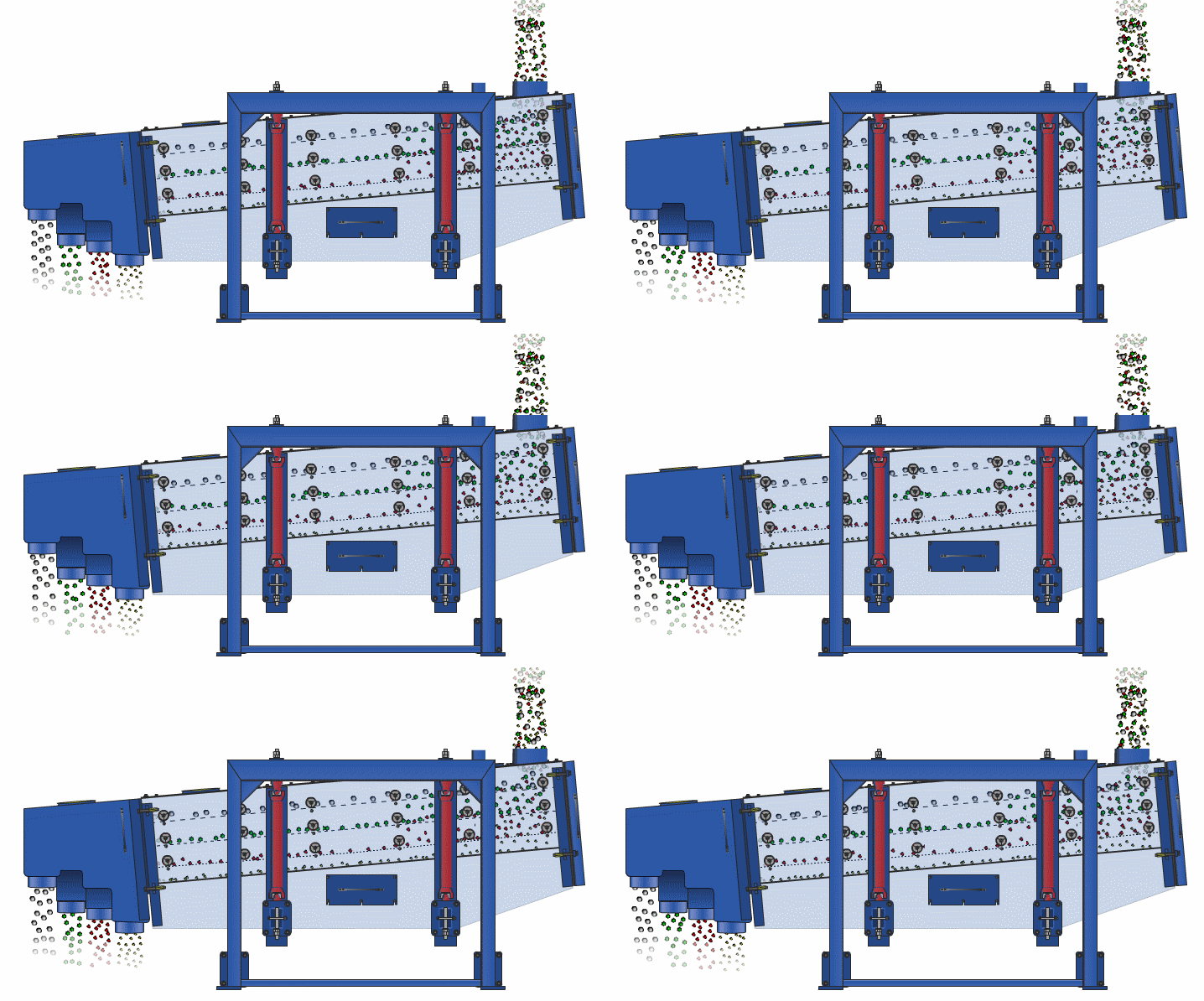
Our 3D animation demonstrates the internal screening process of a rectangular gyratory screen. The cutaway view shows how the drive system moves the screen box, how material travels across the mesh, and how different particle sizes are collected through separate outlets.
The video focuses on three operating stages:
- Screen Box Motion: The drive system generates controlled reciprocating-gyratory movement across the screening decks.
- Particle Separation: Material spreads and stratifies on the screen mesh, allowing smaller particles to pass through the openings.
- Multi-Grade Discharge: Different particle size fractions are directed to separate discharge outlets for collection.
Video Key Moments
Follow the scenes in this clip, from screen-panel maintenance to inclination adjustment and motion trajectories. Select a timestamp to open the corresponding scene on YouTube.
00:00 Screen box and discharge outlets
00:10 Opening the screen-deck compartment
00:25 Sliding out a screen panel
00:40 Refitting the screen panels
01:00 Adjusting the screen-box inclination
01:10 Comparing screening motion trajectories
How Does a Gyratory Screen Work?
The gyratory screen working principle involves four continuous stages: material feeding, distribution, screening, and classified discharge. The drive system produces a reciprocating-gyratory motion that keeps material moving across the screening surface while allowing particles to separate by size.
1. Material Feeding
Dry powders or granules enter through the feed inlet and reach the upper screening deck. A controlled feed rate helps distribute the material evenly and prevents excessive loading in one area.
2. Material Distribution
The gyratory movement spreads material across the screen surface and moves it toward the discharge end. Smaller particles gradually migrate toward the mesh as the material bed moves and stratifies.
3. Particle Size Separation
Particles smaller than the screen openings pass through the mesh to the lower deck. Larger particles remain on the screening surface and continue toward the discharge outlet.
In a multi-deck machine, material passes through successive screening stages with different mesh apertures.
4. Classified Discharge
Each screen deck separates a specific particle size range. Oversized, intermediate, and fine fractions leave through different outlets, allowing continuous collection of multiple product grades.
Gyratory Screen Motion & Material Trajectory
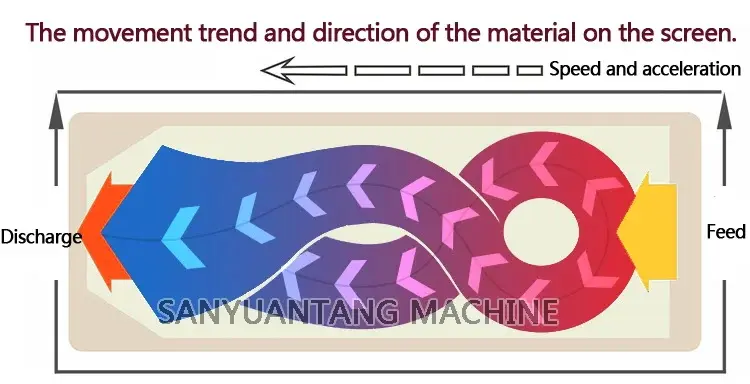
A gyratory screening machine uses controlled reciprocating-gyratory motion to distribute and transport material across a rectangular screening surface. The drive moves the screen box through a repeated trajectory, promoting material spreading, particle stratification, and progressive movement toward the discharge end.
Compared with screening systems that rely on stronger vertical vibration, this motion provides relatively gentle material handling and repeated particle contact with the mesh. It is particularly suitable for dry, free-flowing materials requiring accurate multi-grade classification.
The operating trajectory and material retention time depend on the drive arrangement, screening deck design, feed rate, and material characteristics.
How Screen Mesh Separates Different Particle Sizes
The screen mesh determines the nominal particle size boundary between retained and passing material. In a multi-deck gyratory sifter, the upper decks generally use larger openings, while lower decks use finer mesh to separate smaller particles.
For example, a sand screening system using 20, 40, and 70 mesh cut points can produce four nominal particle size fractions.
| Screen Mesh | Nominal Aperture | Screening Function |
|---|---|---|
| 20 Mesh | 0.850 mm | Retains coarse particles above 0.850 mm |
| 40 Mesh | 0.425 mm | Separates particles between 0.425 and 0.850 mm |
| 70 Mesh | 0.212 mm | Separates particles between 0.212 and 0.425 mm |
| Final Undersize | Below 0.212 mm | Collects particles passing the 70-mesh screen |
Actual separation accuracy depends on particle size distribution, feed rate, material flowability, screen condition, and the percentage of near-size particles.
For difficult-to-screen materials, a mesh-cleaning system can be installed beneath the screen surface to reduce aperture blockage and maintain the effective screening area.
Main Gyratory Screen Components
A rectangular gyratory screen consists of a screen box, drive system, screen decks, mesh assemblies, supporting structure, and discharge outlets. These components work together to generate screening motion, separate material by particle size, and maintain continuous operation.
| Component | Function & Features |
|---|---|
| Feed Inlet | Introduces material into the screening chamber for controlled feeding. |
| Screen Box | Houses the screen decks and transfers the drive motion to the screening assembly. |
| Drive System | Generates reciprocating-gyratory motion to move material across the screening surface. |
| Screen Decks & Frames | Support multiple mesh layers for particle size classification. |
| Screen Mesh | Separates particles according to selected mesh apertures. |
| Mesh-Cleaning System | Helps dislodge particles trapped in screen openings during operation. |
| Discharge Outlets | Direct different particle size fractions to separate collection points. |
| Support & Suspension System | Supports the moving assembly and helps control vibration transmission to surrounding structures. |
Component arrangement and drive construction vary according to the gyratory screen model and screening requirements.
Gyratory Screen Technical Specifications
Sanyuantang supplies rectangular gyratory screening machines in different sizes and screen deck arrangements for industrial powder and granular material classification.
The following specifications cover our FYBS gyratory screen series. Actual machine configuration and capacity depend on material properties and screening requirements.
| Parameter | FYBS Series Reference |
|---|---|
| Models | FYBS-1536, FYBS-2040 |
| Screening Motion | Reciprocating-Gyratory Motion |
| Screen Mesh Range | 2–200 Mesh |
| Screen Layers | 1–10 Layers |
| Motor Power | 5.5 / 7.5 kW |
| Rated Capacity Range | 0.1–25 TPH |
| Screen Box Speed | 180–260 rpm |
| Screen Box Travel | 25–60 mm |
| Screen Inclination | 5–8° |
Specifications are reference values for the FYBS product series, not measurements taken from the animation. Actual screening capacity depends on the selected model, screen configuration, material characteristics, and operating conditions.
Explore Sanyuantang Gyratory Sifters
We manufacture gyratory screening machines for fine particle classification and high-capacity, multi-grade screening. Our equipment is available with different screen dimensions, mesh configurations, discharge arrangements, and supporting structures.
Typical Materials & Screening Applications
Our gyratory screens are used for dry particle classification, oversized particle removal, and multi-grade separation in mineral processing, chemicals, food production, and other bulk material industries.
| Industry | Typical Materials | Screening Applications |
|---|---|---|
| Silica & Quartz Sand | Silica sand, quartz sand, glass sand | Fine particle grading and multi-grade classification |
| Frac Sand Processing | Fracturing sand, ceramic proppants | Separation into specified proppant size fractions |
| Mineral Processing | Garnet, calcium carbonate, feldspar | Particle size classification and oversized material removal |
| Chemical Processing | Resin granules, industrial salts, soda ash | Granular classification and impurity removal |
| Food Processing | Sugar, grain, starch granules | Product grading and removal of oversized particles |
| Fertilizer Processing | Compound fertilizers, fertilizer granules | Granule sizing and separation of undersized material |
Screening performance depends on material moisture, bulk density, particle size distribution, abrasiveness, and required throughput. We select screen mesh configurations and screening arrangements according to the actual operating conditions.
Gyratory Screen Working Principle FAQs
How Does a Gyratory Screen Work?
A gyratory screen uses reciprocating-gyratory motion to move material across one or more screen meshes. Smaller particles pass through the openings, while larger particles remain on the screening surface and move toward separate discharge outlets.
What Motion Does a Gyratory Screen Use?
A rectangular gyratory screen uses controlled reciprocating-gyratory movement generated by its drive system. This motion spreads material across the screen surface, promotes particle stratification, and moves retained particles toward the discharge end.
How Does a Multi-Deck Gyratory Screen Separate Materials?
Each screen deck uses a selected mesh aperture. Material passing through the upper deck enters the next screening stage, where finer particles are separated again. This arrangement allows one machine to produce several particle size fractions.
What Is the Difference Between a Gyratory Screen and a Linear Vibrating Screen?
A gyratory screen uses a reciprocating-gyratory movement pattern that promotes material spreading and repeated contact with the mesh. A linear vibrating screen uses directional vibration to move material along the screening surface. Equipment selection depends on particle size, material properties, required capacity, and separation accuracy.
What Affects Gyratory Screen Efficiency?
Screening efficiency depends on the feed particle size distribution, mesh aperture, screen area, feed rate, material moisture, bulk density, and the amount of near-size particles. Screen tension and mesh cleanliness also affect separation performance.
Contact Us
Discuss Your Gyratory Screening Application
Sanyuantang provides gyratory sifters and customized screening systems for silica sand, quartz sand, frac sand, industrial minerals, and other dry bulk materials. Our engineers can review your feed characteristics, target particle sizes, required capacity, and installation conditions to recommend a suitable screen model and deck configuration. For equipment selection, please provide your material name, feed particle size distribution, required mesh sizes, processing capacity (TPH), and number of finished product grades.